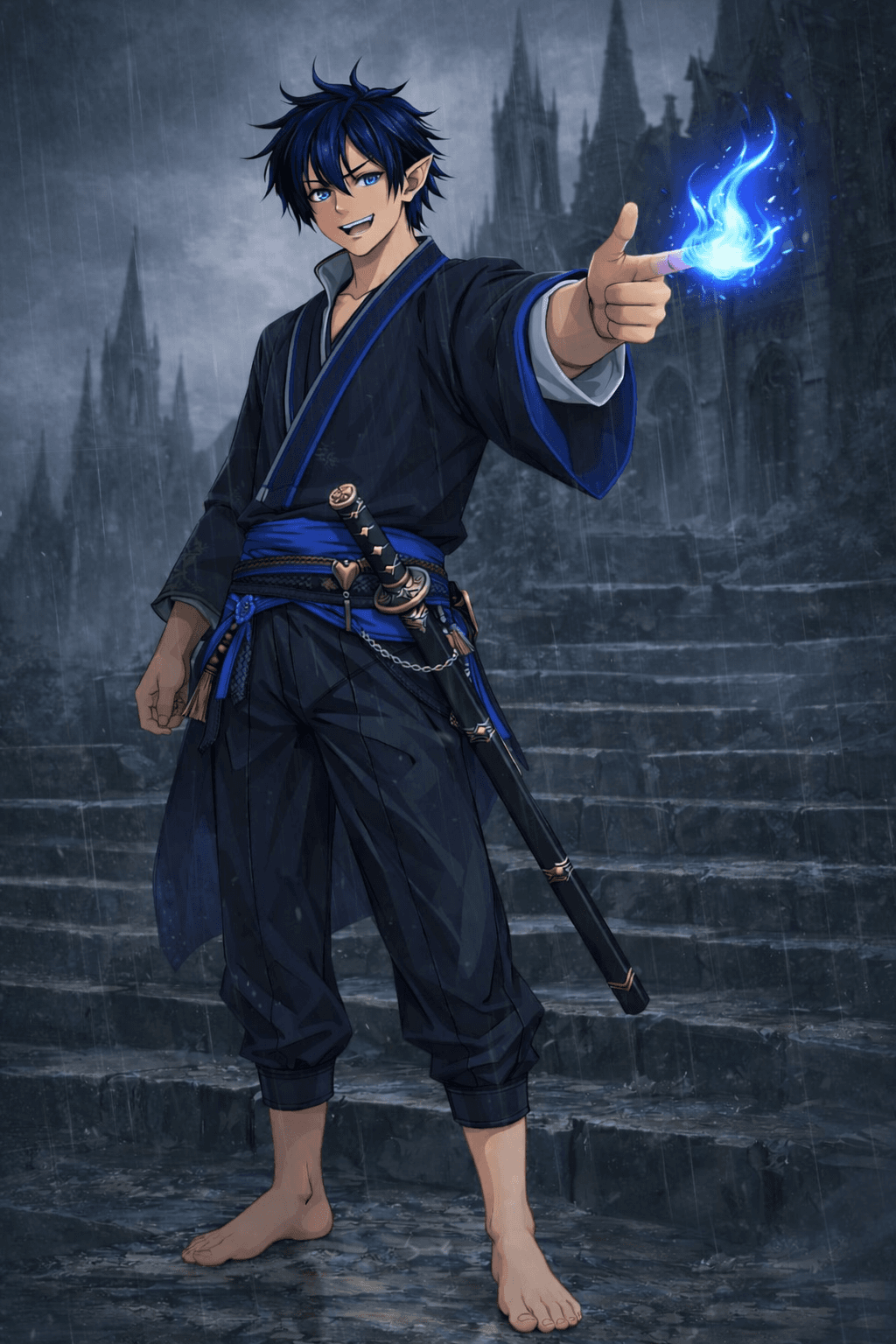
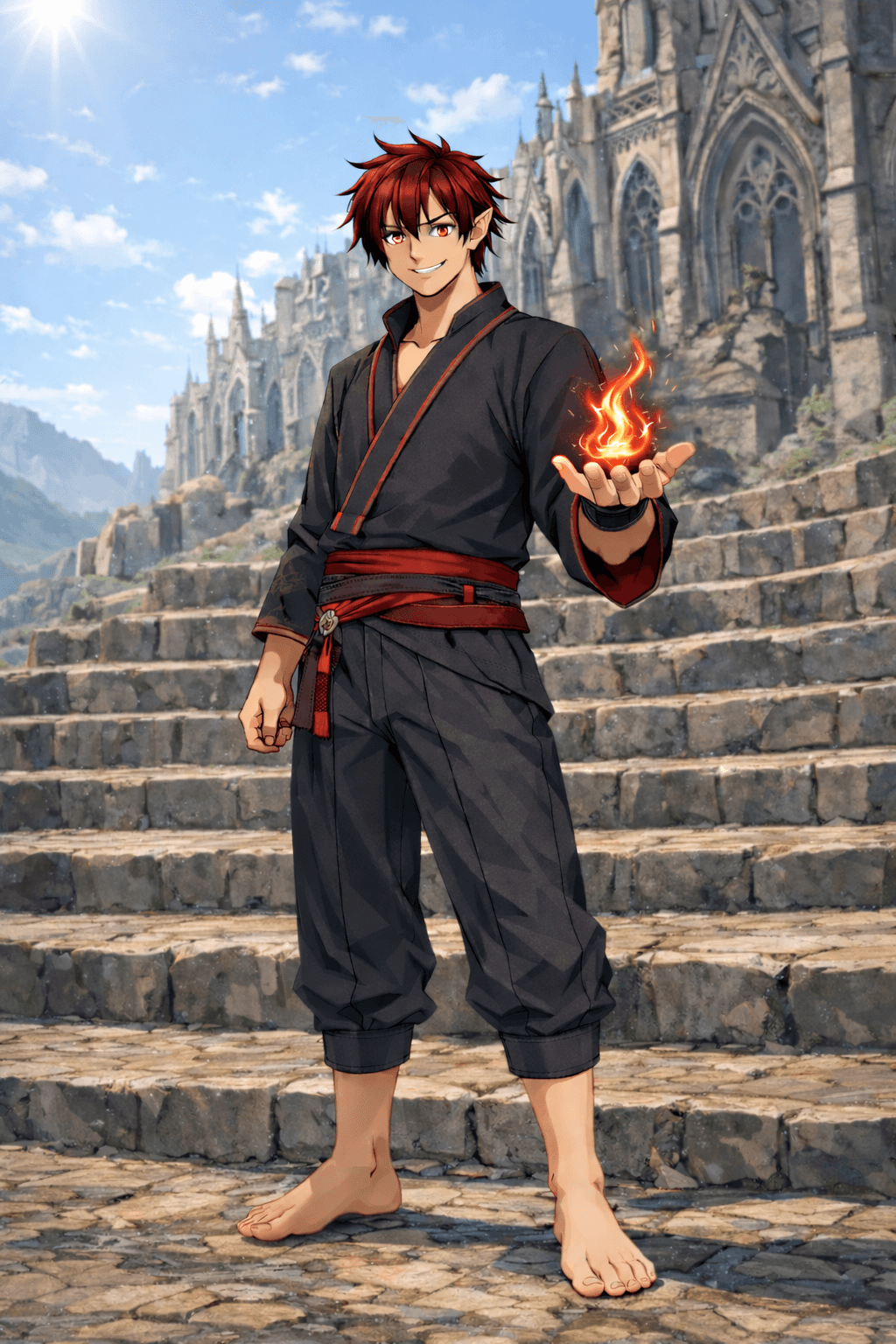
Prologue 8: they always come back
Back Courtyard of House Nakata, North Slope of Mount Futaba — Hiroshima, Province of Aki — Early Summer, the Year 1705
Two Years After the Disappearance of Seijuro
The Nakatas always started early.
And they started early in both senses of the word: early in the day, and early in life. The flat stone in the back courtyard, the one in the corner between the willow and the well, had received the male children of the house before they could fasten their haori on their own. It had been laid there, according to the records of the barracks and according to Jirōbei himself when he lowered his voice to speak of the dead, by the great-grandfather of Jirōbei's great-grandfather. Four generations had stood on it. Four generations had left their sweat on it at five in the morning. Four generations had learned on it to draw the katana before the adversary's eye finished blinking, or had failed to learn it, depending on what the blood carried.
At that hour — the sun still red, the grass wet with dew — a short, rhythmic breath rose from the stone. The breath of a child.
He had silver-white hair plastered to his forehead by sweat. Eyes closed. Spine straight. Hips low. Both palms pressed flat against the stone, shoulders perfectly aligned with his wrists. Up, down. Up, down. He was not counting.
The old man was.
Jirōbei Nakata, just turned fifty-five, sat on the edge of the engawa with an old ceramic bowl between his knees and a voice that was no longer the voice it had been but could still count well:
"Forty-seven."
"Forty-eight."
"Forty-nine."
"Fifty."
The boy held himself up.
He held himself up with elbows locked, without trembling, in a position no manual of the barracks would have demanded of a child his age and that in this house had been demanded for more than a century. He held it deliberately one heartbeat longer than necessary. And only then did he come down.
"Fifty-one," said the grandfather, without raising the bowl.
"That was my own will," said the boy, without opening his eyes.
Jirōbei almost smiled.
He almost did and did not, because the rule of the house was that too: that the old man not smile, lest he spoil the discipline. But inside him a small old warmth was rising, the kind that had for years gone by the name of Seijuro. The boy down there on the flat stone, just turned five, had spoken like a small man from before he could speak. He spoke early. He spoke whole. He said will instead of want. He said grandfather instead of grandpa. At four he had corrected the wet nurse on the order of the months; at five he had corrected passing soldiers on the route of the western road when they had spoken it wrong.
Speaking early, in that house, was almost a second form of obedience.
"Stand up," said Jirōbei.
The boy stood.
He had the body of a five-year-old, yes; but his shoulders already had the dry line of those who had spent a long year in a back courtyard. Tiny. Compact. Beneath the pale cotton of his training clothes, his thighs held the full weight of his torso without trembling.
Jirōbei pointed at the willow with his chin.
"Twenty cuts with the bokken to the right, twenty to the left. Do not raise the elbow."
"Yes, grandfather."
"When you finish, water from the well. One cup. It is hot but I do not want your legs to go loose."
"Yes, grandfather."
The boy took the bokken from the stump of the willow, where the old man left it leaning each dawn, and began. Twenty cuts to the right. The classic two-handed grip, right hand high against the tsuba, left hand low at the end of the tsuka, knuckles aligned just as his grandfather had taught him the first day and just as he had been doing, without a single error, for the past eleven months. No Nakata of the house, in four generations, had ever lifted a bokken any other way. None had required more than three corrections to place the hands correctly. The grandson, at four years and two months, had required two. The grandfather had noted those two corrections in a notebook with black cloth covers that had been in the family since the great-grandfather and in which were set down, briefly, the things worth remembering.
Jirōbei watched him.
He watched the clean cut, high, brief.
He watched the path of the wooden edge — exact, parallel to the shoulder, no wobble at the end.
He watched the boy's hips, low, solid, anchored to the ground as in the old Edo manual of four generations ago.
He thought: It is here.
He thought: Here is what came from my father, and from my father's father, and from my father's father's father. The katana of the Nakatas. It is here. It has not been lost.
And he lowered his gaze to the bowl, so that what had not slipped from his eyes for months might not slip from them now.
The boy finished the cuts.
He drank the water from the well in silence. He left the cup upside down on the wood of the well rim, the way his father had left it when returning from campaign, a gesture his grandfather had taught him six months earlier and the boy had not forgotten a single dawn. Then he came up to the engawa and stood there, wet, waiting for what was to come. He knew that when his grandfather set the bowl aside, what came next was to listen.
Jirōbei set the bowl aside.
"Come here," he said.
The boy came.
"Sit down."
The boy sat down on the flat stone, both hands open on his knees.
Jirōbei looked at him from the height of an old man and from the height of an officer. This time there was no bowl between his knees. His two hands were empty, one on top of the other, on his thigh.
"Today is not a day like the others, grandson."
"Why, grandfather?"
"Today I am taking you to the barracks."
The boy did not answer right away.
He turned the words over.
That too was the way of his father and of his father's father and of his father's father's father: not to answer before he had weighed the word that came in. The grandfather let him weigh it. He let the morning sun weigh it, and the sound of the well, and the cicada that had begun to sing in the trunk of the willow.
"To the barracks for what, grandfather?" he asked at last, still not raising his head.
"To enlist you in the army."
This time the silence was longer.
The boy did not look up. He kept staring at the stone between his feet. It was the same stone on which he had done fifty-one push-ups that dawn and twenty cuts with the bokken to the right and twenty to the left without flinching. It was a stone he knew well.
"And what am I going to do in the army, grandfather?" he asked at last, still without raising his head.
Jirōbei drew breath slowly.
He drew the breath that old men draw when they are about to say things that weigh.
"What this family has always done, grandson. You are going to train. You are going to learn discipline. You are going to learn to obey when one must obey, and the rest. You are going to meet other boys and learn how to care for a rifle and how to load it, and how to sleep when the body asks not to sleep. You are going to eat what is given and not what you fancy. You are going to grow strong. As strong as your grandfather was at your age." He paused briefly. "As strong as your father was at your age."
The boy raised his head for the first time.
The red eyes — that deep red Jirōbei had seen for the first time when the boy was three years and four months old and had not yet learned to look at without flinching, because they were the eyes of the son who had not come back — fixed on the old man's.
"My father did this, grandfather?"
"Your father did this."
"At five?"
"At five."
"And you?"
"I did too. My father took me to the courtyard of the barracks the day I turned five. Just as his father had taken him. Just as his father's father had taken him. In this house, men enter the army early, grandson. Earlier than any manual of the general staff would recommend. But also earlier than any Nakata has ever lamented."
The boy nodded.
He nodded once.
"Why must one grow strong, grandfather?"
Jirōbei looked at him.
He looked at him with care.
This was the question that one answered badly in haste. This was the question whose answer would take the boy years to understand, even if he heard it whole now and even if he repeated it from memory.
Jirōbei answered it all the same.
"To protect those one loves, grandson," he said. "For that. For nothing else. For nothing worth as much as that. You grow strong to protect your own. And if you have no one of your own" — and here the old man's voice dropped a step, against his will — "you grow strong to protect those who could be your own, and those who do not even know you, and the children like you. That is why your father went, grandson. For that. So that you, now, in this patio, could grow strong without any gray shadow slipping in from the eastern path."
"Did he do it for me?"
"He did it for you, yes. And for more. But for you also."
The boy lowered his head again.
He turned the words over again.
Then he raised it once more and said, in that clean voice that startled the wet nurse and Raisuke's soldier and anyone who crossed the fusuma of the dining room of House Nakata:
"Then I go."
"Then we go," the grandfather corrected him.
And he laid, as he had been laying since the boy was twelve days old, his open hand on the back of the boy's neck.
Without pressing. Without letting the weight fall. Only resting.
It was the Nakata gesture. It was everything that, in this house, passed for affection.
And it was enough.
Main Yard of the Hiroshima Military Base, West District of the City — Morning of the Same Day
The Hiroshima base was the oldest in the west, and you could see it.
Walls of gray stone cut in uneven blocks from the previous century, a cedar gate reinforced with bands of blackened iron, two watchtowers at either end of the north wall, a rectangular parade ground long enough to form an entire company without the officer at the far end losing sight of the one at the head. In the center of the yard, a bamboo flagpole with the banner of the general staff — the simplified sun, not the imperial one — hung slack at that hour, no wind.
Jirōbei went in through the gate holding his grandson's hand.
No one in the guard corps asked him for papers.
No one had asked Jirōbei Nakata for papers at the Hiroshima base in thirty years.
The boy, whose silver hair the grandfather had combed with the open palm before crossing the gate, looked at everything inside with the calm with which a Nakata looks at places the first time. He did not let himself be distracted by the flagpole. He did not let himself be distracted by the regulation swords leaning against the wall. He did not let himself be distracted by the smell of rifle grease coming from the armory shed. The only thing that caught his eye was a line.
A line of men and boys in front of the east wall.
They were standing more or less at attention, with the sad asymmetry of a first morning. The tallest was three times the boy's size. The shortest, not counting Nakata himself, still had two heads on him. There were about twenty of them. Village boys with backs already too stooped from work in the fields. Sons of small samurai without land. Two or three teenagers from Hiroshima city with their hair cut by their mother's shears that very night, a mother who had been mourning them in advance for years.
Jirōbei pressed his palm against the boy's neck.
"There," he said. "Fourth position from the right. That is where you will stand."
"And you, grandfather?"
"Not me, grandson. Not anymore."
The boy did not ask why.
He walked to the fourth position from the right and took his stance.
Feet apart at shoulder width. Head high. Eyes forward. Hands flush against his thighs, fingers together, palms flat to the body, exactly as his grandfather had taught him at the fusuma of the dining room of House Nakata when he was not yet a meter off the ground.
And then the instructor appeared.
Hayato Inoue was forty-one years old, broad-shouldered, square-faced, and had carried in his right hand for the past seventeen years a dark-wood staff the length of a forearm. It was not a weapon. It was a metronome. When he was calm he tapped it softly against his left palm, once every two paces, toc... toc... toc. When something did not sit right, the taps quickened, toc-toc-toc-toc, and new cadets learned to read the rhythm of that staff the way harbor fishermen learned to read the wind: by sheer instinct of survival.
He came out of the office at the far end of the yard, walking slowly.
Toc.
Toc.
Toc.
The cadets held formation. They learned, without knowing it, their first lesson of the morning: the army always comes to you walking. Never running.
Inoue stopped three paces from the line.
He raised his head. He swept his eyes over that line for the first time in his career, and began the reading, a sheet of rice paper with the roster names propped in his hand. He read it aloud, position by position, from left to right. The cadets answered with a dry here. The older ones said it loud. The younger, not so loud. Inoue moved on.
"Tora Yamashita."
"Here."
"Daisuke Mori."
"Here."
"Kenji Watanabe."
"Here."
And then the staff stopped in midair.
It did not come down.
Inoue had reached the fourth position from the right. He had lowered his eyes from the rice paper to the uniform. He had lowered his eyes from the uniform to the face. And the face was that of a five-year-old, with hair the color of a new moon and eyes the color of dying fire.
"And you, who are you?"
"Seijuro Nakata," said the boy.
The dark-wood staff hung suspended in midair one second more.
And then it began to strike his left palm faster. Toc-toc-toc-toc-toc.
Inoue lowered his gaze to the paper. He raised it. He lowered it again. He searched the back of the yard with that precise quickness of officers accustomed to locating the exact source of things. He found Jirōbei beside the flagpole, hands clasped behind his back, head slightly bowed. He held the old man's gaze for two full seconds. Jirōbei returned the gesture with the briefest tilt of the head, almost imperceptible: yes, it is me. Yes, he is mine. Yes, that is how it is.
Inoue nodded once, slow.
The staff calmed. Toc... toc... toc.
"Welcome, Cadet Nakata," he said, his voice composed again. "Stand fast."
"Yes, sir."
Inoue resumed the reading.
"Toshio Kimura."
"Here."
"Akira Suzuki."
"Here."
And then the staff stopped again.
This time at the tenth position from the right.
"And you, who are you?"
The voice that answered was a small voice.
As small as Nakata's.
"Ren Sato, sir."
There was, in the line, a very slight movement. Nakata, without fully turning his head — because that, at attention, was not done — slid his eyes from the corner of his right eye toward the tenth position. He could see no more than a crop of short black hair and a small ear. Another boy. Another his own age. Another. In the whole yard, two points in the line were the wrong size.
Inoue processed this second one more slowly.
The staff, which had gone back to tapping soft, sped up again. Toc-toc-toc-toc.
"Who enlisted you, Sato?"
"I did, sir."
"You alone?"
"Yes, sir."
"Parents?"
"None, sir."
"Guardian?"
"None, sir."
"Where do you come from?"
"From the south district orphanage, sir."
Inoue stood looking down at him for a long time. The staff went up, came down, went up. Toc. Toc. Toc. He did not look at Jirōbei this time — there was no Jirōbei to look at — and there was, on the rice paper, no great surname behind the name. There was only a tiny boy who had enlisted himself. Inoue noted something in the margin of the paper with a small piece of charcoal he drew from his pocket. He closed the pocket.
"Welcome, Cadet Sato," he said. "Stand fast."
"Yes, sir."
And he went on with the reading.
The line was finished two minutes later.
When the last cadet said here, Hayato Inoue carefully folded the rice paper, slipped it into the breast of his tunic, took two steps back to position himself in the center of the yard — so that the line stood entirely before him and the slack flag of the pole hung directly behind him — and rested the staff against his right thigh. When the staff fell silent, it was because the voice was about to speak.
And the voice, in Inoue, spoke as he had learned to speak after seventeen years of receiving cadets: without haste, without shouting, without condescension. Like a man who knows that those words will lodge somewhere in the brains of those who hear them for the next forty years.
"Look around you," he began.
The cadets looked around without moving their heads.
"Look at this yard. These walls. The east wall, which is the oldest in western Japan. The two north towers, which have stood for one hundred and eighty years. One hundred and eighty years ago, in this very yard, another man like me was welcoming another line like yours. This base is no ordinary barracks. This base is the place where Japan decided, long ago, that it was going to defend itself from what comes from the other side."
He paused.
He shifted his weight from his left leg to his right.
"And from times so old that the records of the general staff no longer have exact names," he said, "what comes from the other side are the akuryō.
"Some of you have seen them. Others have not. That does not matter this morning. What matters this morning is that you know what they are and what you will have to do about them. Because in this country, since the records have been records, the akuryō have appeared. They appear, they kill, they vanish. They come back. Sometimes it takes them twenty years to come back. Sometimes three months. We do not know why they take longer some times and shorter others. We do not know what brings them and we do not know what takes them. The only thing we know is that they come back.
"Long ago, this country made a choice. Since we had before us an enemy that did not die like an enemy and to whom no truce could be offered, we decided that the fields and the roads and the cities would go on as they had always been — the rice, the carts, the horses, the wooden houses — and that everything the country had of strength and time and gold would be poured entire into a single thing: into arming the army. The smiths, instead of making bars and tools for the farmers, set themselves to making rifles. The gunpowder, instead of going into fireworks for the festivals, was made into ammunition. The brightest heads of every generation, instead of going off to the fields or to commerce, came to the barracks. That is what you will have in your hands tomorrow" — he pointed with the staff, almost without looking, toward the armory shed — "carbines and rifles that came out of two hundred years of pushing the smithing of this archipelago in a single direction. That is not because the shōgun had a pretty dream. That is because we have been at war from before any Nakamikado was a Nakamikado, and because a war that does not end forces a country to tighten whatever must be tightened."
Some of the older cadets, those with the more weathered backs, had begun to nod ever so slightly.
Inoue took two paces forward.
He raised the staff again.
"And now listen well, because this is said only once, and tomorrow no one will repeat it for you.
"The akuryō are gray. They have no faces. They have an enormous mouth when they attack, full of teeth, that opens in the upper half of the body when they are ready to bite. They do not feel pain. This last point I will say again" — and he gave a sharp tap with the staff against his left palm, toc — "they do not feel pain. If you shoot one in the leg, it goes on walking. If you blow off both its arms, it goes on walking. If you take all four limbs from it" — and this in Inoue was almost a sermon, he recited it like a litany — "it stays alive. The only thing that kills an akuryō is a clean strike to the head or to the heart. There is no third point. If you doubt, miss toward the head. The head is always larger than the heart.
"They appear in waves. Never one at a time. When one appears, count to three and there will be twenty. They attack in enclosed spaces, they attack in fog, they attack at dawn and at dusk. They attack you from where you are not looking. The intelligence they have is the intelligence of the pack. Where they are not stupid is in numbers."
Inoue fell silent for a moment.
He lowered his eyes to the floor of the yard, to the yellow dust. He looked at the shadow of the flagpole. He raised his eyes again.
"And for the past few centuries," he said, and here his voice dropped another step, as if someone inside the base were listening, "in the reports of the general staff another word has begun to appear. Different from akuryō. A word you are likely hearing today, between these walls, for the first time in your lives, and that, outside this yard, you will not repeat except among yourselves and before a superior. That word is kōtei.
"The kōtei are different. They are not gray. They are not faceless. They are people. They have the shape of people. They have eyes, voices, clothing. Sometimes they speak languages no one here understands. Sometimes they speak an old Japanese from centuries past. The records of Edo say there have been blond ones, dark-skinned ones, ones with yellow eyes. The difference between them and a normal human is that a kōtei, in a fair fight, is two or three times faster than any of you standing in this line. Stronger than you will ever become. More resistant. And, in some cases" — calculated rhetorical pause, toc, very slow — "they do things that gunpowder does not yet know how to do. Things that those who tell of them cannot quite name. Things that, in the reports, are written around. Call it magic, if you like. Call it power. Call it whatever helps you not run away when the time comes to see it. The general staff calls it, simply, kōtei. And I will tell you one thing, cadets: against an akuryō, a well-aimed carbine is enough. Against a kōtei, a carbine is good for hurting. Not always for killing."
There was a silence in the line.
A clean silence, settled, the kind Inoue liked because he knew how to read it.
He raised the staff.
He lowered it.
And then he said what he had to say that morning.
"Of the akuryō, cadets, no one has appeared for two years."
He moved his head very slowly from one end of the line to the other, looking at them one by one.
"Two full years. In the entire archipelago. Not one. Of the kōtei, the same: for two years no report has come in. That is how it is. I would not know how to explain it. There are those, within the general staff, who call it the old peace. There are those who call it, simply, luck. To me it is all the same what they call it. The only thing I know is this, and I am going to tell it to you to your face because tomorrow will be too late."
He paused.
He paused long.
"They always come back.
"They come back. They come back tomorrow, they come back the day after, they come back in five years, they come back in fifteen. They come back when you least expect it. They come back when you have your wife at home and a newborn in the house and you have convinced yourself that the old peace was forever. They always come back. That is why this army, in these two years of calm, has not stopped training a single day. That is why, in those two years, not one afternoon has the yard stood empty. That is why you are here today, children and grown men" — and here he looked deliberately at the fourth and tenth positions from the right — "instead of being in your homes. Because when they come back, the only thing that is going to stand between you and your own will be these walls, these rifles, and what you yourselves are capable of doing with all that. And that is not learned in a day."
He lowered the staff.
He set it back against his thigh.
"From today, cadets, you are soldiers of the Imperial Army of Japan. Welcome to Hiroshima."
And for the first time the entire morning, the whole yard answered with a single voice:
"Yes, sir!"
It rang out loud.
It rang out even from the fourth and tenth positions from the right.
It rang out, above all, in the ear of old Jirōbei Nakata, who still stood beside the flagpole with his hands clasped behind his back and his head slightly bowed, and who closed his eyes for an instant before turning around and walking out through the gate without looking at his grandson, because the rule of the house was that too.
That the old man not look twice.
Lest he spoil the discipline.
Mess Hall of the Base, West Wing — Midday of the Same Day
The mess hall of the Hiroshima base was a long wooden hall with two rows of running tables and a smell of boiled rice and miso soup that came in through the nose before one came in through the door. At the back, in the kitchen, three cooks served the rations on lacquered wooden trays divided into two compartments: a large one for the rice, a small one for whatever else. That midday it was a piece of dried fish and pickled daikon.
Nakata took his place in the line.
They handed him the tray — which was heavy enough for one five-year-old hand, though the boy took it with both without showing it — and he walked to the first empty seat he found. He chose the far end of the table farthest from the wall: a spot with no one to his right, no one to his left, no one across. It was the spot one took when one knew nobody and preferred not to pretend otherwise.
He sat down.
He set down the tray.
He took the chopsticks — regulation issue, too long for his small hands — and separated two grains of rice from the heap.
And then he felt them.
The eyes.
He felt the big cadet at the table opposite, who had been eating for two minutes without looking at his plate, looking at his hair. He felt the one at the table on the right, two seats over, whisper something to the man beside him and laugh under his breath. He felt the whole conversation of the mess hall — the dull hum of forty cadets talking — drop by two notches when he came through the door, and take three long minutes to climb back up. Five years old, hair the color of a new moon, eyes the color of dying fire, and a surname that Hayato Inoue had said aloud in the yard but that was already running, table by table, between the rows of the mess hall.
Nakata did not lift his eyes.
He concentrated on the two grains of rice he held between his chopsticks.
And while he concentrated on them, a thought passed through his head that was, without his knowing it, the first adult thought of his life: so this is how it is going to be, I suppose. So it is going to be every mess hall, every yard, every barracks of every city they take me to, for many years. It was a sad thought, but the boy did not allow himself, not for an instant, to give it that name.
And then, on the other side of the tray, another tray was set against his.
"Do you mind if I sit next to you?"
The voice was small.
As small as his.
Nakata raised his head.
It was the other boy.
Short black hair, cut at home with sewing scissors. Brown eyes, round, alert. Cheeks still with the soft fat of small children, different from the dry, angular face of Nakata himself. His feet, dangling from the bench, did not reach the floor. The tray, exactly as heavy as Nakata's, he was holding with both hands for the same reason: because at five years old, an Imperial Army tray takes both hands.
"I don't mind," said Nakata.
The other boy sat down.
He arranged the tray, squared himself in front of it, gathered the chopsticks together, did the small bow of the head that was done in his orphanage before eating and that no one in this hall of forty older cadets did at all, and only then — when the ritual was complete — did he look at the boy beside him.
"I'm Ren," he said. "Ren Sato."
"Nakata."
"I know that already. The sergeant said it."
"Yes."
There was a brief silence. Ren looked at his dried fish. He poked it with the right chopstick, without raising his eyes. He had a little trouble, because the army chopsticks were very long. On the third try he got it.
"I saw you before," he said. "In the line."
"And I saw you."
"You were the fourth."
"You were the tenth. I counted."
"You counted? I can't count that fast."
Nakata did not answer that.
Ren put a small piece of fish in his mouth, chewed twice, and lowered his voice, though there was no need to lower it there:
"Hey."
"Yeah."
"You're five, right?"
"Five, yes."
"Me too. Five. I just turned."
"Same."
"In the whole mess hall it's just the two of us."
"Looks like it."
Ren looked over the tray, slowly. He looked at the table opposite. He looked at the one beside. He looked at the back, where the tallest were. He looked at Nakata again.
"Do you want to be friends?"
Nakata thought about the answer two seconds longer than a normal kid would have thought about it.
He thought about what his grandfather had said to him that very morning about obeying when you have to obey, and the rest. He thought about the whole mess hall staring at his hair. He thought about the open hand of his grandfather on the back of his neck, and about the sentence the old man had not quite finished forming when he had spoken of protecting those one loves and those who could be one's own.
And it seemed to him that a kid his age sitting on the other side of a tray was, perhaps, the closest thing to a friend that life was going to put in front of him for a long time.
"Okay," he said. "Let's be friends."
Ren smiled for the first time.
It was a tiny smile, without showing the teeth, made by a boy who was learning to smile late.
And the two of them took the first bite of dried fish at the same time, without having agreed on it.
"Hey, Nakata."
"Yeah."
"Why are you here?"
Nakata chewed slowly.
"My grandfather signed me up."
"At five?"
"At five, yes. They signed up my father at five. They signed up my grandfather at five. My grandfather's father too. In my house, that's how it's done."
"All of you?"
"All of us."
"Weird."
"It's what my grandfather decides and I do what my grandfather says."
Ren nodded, as if that mechanism — passing things from a father to a son — were something he had heard of but did not quite understand from the inside. He picked up a piece of daikon. He chewed it.
"And you?" Nakata asked.
Ren set down the chopsticks.
He laid them crossed on top of the tray.
"I don't have a family," he said, and he said it flat, like he had said it many times before. "That's why I signed up."
"You don't have anybody?"
"I had parents. But some akuryō killed them when I was still a baby."
"Oh."
"I was still a baby," Ren repeated. "I don't remember them. I remember a little bit of a village, and a street, and sometimes I remember a woman who used to feed me and I say it's my mother, but maybe it's not my mother. Maybe it was a neighbor. I don't know."
He paused briefly.
He picked up the chopstick, dropped it, picked it up again.
"What I know they told me at the orphanage. That my parents died in one of the attacks of the first year. That I would have been a few months old. That a soldier passing through took me out of the village and left me at the nearest orphanage, which was one in the east."
"In the east."
"In the east. I was there until I was three. But those three years, kids kept arriving. Kids without fathers. Kids without mothers. Some days three came, the head matron said. They said that every time an akuryō showed up somewhere, a kid would later show up at the gate. When there were too many of us and we wouldn't fit, they started sending us west, where there were fewer akuryō. I got Hiroshima."
"When did they bring you?"
"I don't remember. I was still really small. The head matron says I came in a little before the peace. She says the last kid came with me and two others. She says after that the gate stayed shut for many months, and nobody came."
"That would be the summer of two years ago."
"That would be it," Ren said.
He nodded.
He picked up the left chopstick. He set the chopsticks side by side, in line. But he still did not eat.
"And the orphanage in Hiroshima," Nakata asked, in a low voice, "is it still full?"
"Full, yes. There are kids even out in the hallway. Even though they don't come anymore, the ones who are there don't leave. Even though the little ones don't remember why they came, full it stays."
There was a long silence.
A silence that lasts longer than the breath of a chopstick between two grains of rice.
"And that's why you signed up by yourself," Nakata said, slowly.
"That's why I signed up by myself."
"At five?"
"At five. Today. This morning. I jumped the wall, Nakata. Nobody signed me up. Nobody brought me. I came and put myself in the line."
"Why?"
Ren set down the chopsticks.
He took a moment to answer. Words did not come to him as fast as they came to Nakata. You could see he thought them through first.
"Because I don't want the akuryō to come back."
"But the akuryō are going to come back anyway," said Nakata. "The sergeant said so."
"Yeah. But if they come back, I'll be training. And if I'm training, maybe I can kill them. And if I kill them" — and here the small voice broke for a microsecond, no more, and pulled itself together at once — "there won't be more kids without parents."
He paused again.
"It's awful," he added, as if that word explained the whole sentence. "Being left without a father and a mother is awful, Nakata. I don't want anybody else to have it."
Nakata looked at him.
He looked at him with that look of his, the red eyes still, not blinking more than they should, the look that, on a five-year-old face, made adults uncomfortable.
"That's a really good thing," he said, slowly.
"Yeah?"
"Yeah, really good. It's what my father did, too."
"Your father?"
"My father. That's why he isn't here. He left so the akuryō wouldn't come back. So nothing else would happen to anyone. And that's why there aren't any akuryō now."
Ren stared at him.
"Really?"
"Really. That's what my grandfather says."
"And where did he go?"
"I don't know. Every time I ask my grandfather he tells me I'm not ready yet to know."
"Okay then. We'll get ready together and we'll go where your father went."
Ren did not ask anything more. He had already decided.
He picked up the chopstick. He picked up a piece of daikon. He put it in his mouth.
And the friendship was settled there, just like that: two five-year-olds eating daikon at the same time, at the table farthest from the wall in the mess hall of the oldest base in the west of Japan.
Parade Ground, Hiroshima Military Base — Predawn of the Following Day, Around Four
They got him up at four.
Ren too.
They got everybody up.
They did it the way the Imperial Army had been doing it for a hundred and eighty years, and that no cadet had ever forgotten, even one who was five years old: a short, sharp bugle call, two officers' voices shouting out, out, out down the length of the barrack room, and the raw light of the under-instructor's lamp shaking on the faces of the children and the boys while their feet found their boots and their hands buttoned their tunics. They had two minutes to dress. Three to reach the yard. If anyone took four, the whole group ran until the laggard learned to count.
They made it in three.
But just barely.
Hayato Inoue was already in the center of the yard.
The staff, this time, was not tapping the palm slow. It was tapping it now at the rhythm of work. Toc-toc, toc-toc, toc-toc.
"Six miles," said Inoue, without greeting. "Up the north road. Round trip. The last man to cross the gate runs three more with the lead belt. The two youngest" — and here he looked deliberately at the fourth and tenth positions — "go with reduced weight. I am not doing it out of kindness. I am doing it because the army has no use for two cadets with their backs broken at five years old."
No one answered.
No one answered Inoue with words at that hour.
They went out.
The run was what it was: hard. Six miles with the sun still down, the cold predawn air cutting at the lungs of boys just woken, the north road climbing on the first stretch and dangerous on the second with loose stone. The older ones held up. The middle ones held up as best they could. The little ones, the two little ones, the two little ones from the mess hall the day before, ran. They ran without looking back. They ran without looking forward. They ran the way the Nakata blood had been running for half a year through the back courtyard of Mount Futaba — Nakata — and the way he had never run in his life — Ren.
The last man in was a fifteen-year-old cadet from Hiroshima city.
By six o'clock he was already running two more miles with the lead belt at his waist.
And in the yard, the serious work began.
A hundred push-ups.
A hundred squats.
A hundred sit-ups.
That was for the older ones. For the younger ones, as many as they could do. Though the unwritten rule of the barracks — which no sergeant ever said aloud and every cadet learned the first day — was that the one who asked for less got less. And Nakata did not ask for less.
A series of carries with sacks of straw on the shoulder out to the back shed and back. Another series. Another. Jumps onto the wooden box, drops off the wooden box, three minutes of plank on the yellow dust of the yard, three more minutes, three more minutes. The temperature climbed. The sun rose. The temperature climbed more. When the first cadet started to retch, Inoue said, without looking:
"If he vomits, let him vomit and keep going."
The cadet vomited and kept going.
When the second cadet's legs gave out and his knees slumped to the ground, Inoue said, without raising his voice:
"On your knees nothing is learned. On your knees you get up and keep going. If you do not get up, you go to the medical shed and tomorrow you are not here."
The cadet got up and kept going.
He said it like a litany. He said it without sadism, without theater, without taste for it. He said it with that professional indifference of officers who have seen twenty-three classes pass before them and know that, of those twenty-three classes, half learn only when the body can no longer do it. Inoue was not punishing the cadets that morning. He was teaching them to hold on against the akuryō and the kōtei who would come back two, five, ten, fifteen years later. They always come back. And when they come back, they do not forgive soft feet.
Nakata held up.
He held up through the run. He held up through the push-ups. He held up through the squats. He held up through the plank and the box jumps and the sacks of straw. The push-ups, in particular, he did with an ease that did not escape Inoue's notice: the small cadet at the fourth position from the right took position with his hips low, his back straight, both palms flat on the dust, his shoulders perfectly aligned with his wrists, and went up and down without trembling and without losing rhythm. Thirty. Forty. Fifty. While the others were at twenty and breathing through their mouths, Nakata was at fifty and breathing through his nose. Inoue, without stopping, gave a short tap of the staff against his palm — toc — and went on down the line.
The grandfather has done his work well, Inoue thought.
But beside Nakata — two places to the right — something else was happening.
Nakata saw it when he raised his face for breath.
Sweat was pouring off Ren in streams. Ren's face was red. Ren was shaking on the plank. Ren's knees, in the squats, were buckling inward in a bad way. Ren, on the box jumps, fell four times. The fourth time he stood up with blood on his knee and kept going. Ren, on the carries with sacks, made it twice to the back shed and the third time the sack fell off in the middle of the yard and he had to come back to pick it up and load it again and start over.
But Ren did not stop.
That was what changed it all, that morning, inside Nakata's head.
Ren did not stop.
Not once.
When the fifteen-year-old cadet from Hiroshima city asked permission to sit down, Inoue granted it and sent him to the medical shed. When the fourteen-year-old cadet passed out on the plank, two stretcher-bearers took him away without his knowing. When another cadet, an older one, said between his teeth that he could not and got up only halfway, Inoue said nothing and moved on. But Ren, the boy from the south district orphanage, the boy from the village in the east of which he remembered only a street, the boy of exactly five years, the boy of the wall jumped that dawn without paper or guardian, did not sit down. He did not faint. He did not get up only halfway. He finished with blood on his knee, vomited twice, fell four times, and completed. He completed every exercise. He completed the last repetition. He completed the last carry. He completed the last squat.
When Inoue called the session and said break ranks, Ren collapsed onto both hands and both knees, and from there, head hanging, he looked at Nakata.
He smiled at him.
That tiny smile, without showing the teeth, made by a boy who was learning to smile late.
Nakata smiled back.
And while he smiled back, a thought crossed his head, inside, without a single muscle of his face moving, a very simple thought:
He is my same age. He has never trained. He has never done this before. And he holds. He holds what we who have trained do. This boy is very strong.
He did not say it aloud.
But he set it down.
He set it down the way Nakata cadets set down the things they are not going to forget.
The Parade Ground, the Sword Hall, the Firing Range, and the Roads to the North — Hiroshima, the Years 1705 to 1718
After that, it was what it was.
After that came the months, and the years, and the thirteen long years of calm of the akuryō that the office of the general staff in Edo went on calling, in its reports, the old peace. No attacks. No waves. No reports. No gate of any orphanage opening at night with a child of the east in the arms of a passing soldier. The simultaneous cessation — that rule which old Jirōbei kept signed by the office of the general staff in the drawer of the study at House Nakata — held, year after year, without a break in the waters. And Nakata and Ren, in the yard of the Hiroshima base, trained.
They trained in the mornings and they trained in the afternoons.
They grew up together.
They turned six, and seven, and eight. They turned nine and ten. At six they left the barrack of the smallest and began going to the sword hall on the south wall, where an old master from Edo named Honda put in their hands for the first time a short training katana, no edge yet, the tsuka wrapped in white cotton so it would not slip. At seven they took up for the first time a light carbine — the lighter models from the armory, fitted to the arms of the youngest — and fired in the firing range at the east wall, sitting, the barrel resting on a sack of straw so as not to twist the shoulder. Nakata hit the target on the first try. Ren took three shots, but on the fourth he hit it too. At eight they did the first march of twelve miles with light load on the back, walking side by side for six hours, because it had already become an unwritten rule of the base and because no older cadet had ever dared come between them. At nine they fired standing, without support. At ten they did the first field exercise, with blank cartridges, in the low woods to the north of the base. At twelve, the first full march of twenty-five miles with regulation load. At fourteen, the first exercise with live ammunition.
The exercises surprised the general staff.
In the reports of the Hiroshima barracks for the years 1712 to 1717, the names of the two cadets began to appear in a separate column that Hayato Inoue — promoted to captain in 1713 — signed by hand each month with a handwriting that grew less nervous. The two boys — not so small anymore, Inoue once wrote in the margin, with ink that had dripped from the brush — performed like older teenagers. Then like young adults. Then like patrol officers. And of the two of them, what Nakata did was, in the reports, already something else.
What Nakata had was not endurance.
It was not discipline.
It was not will.
It was what, in the old archives of the barracks, was called, in handwriting older still than Inoue's, the gift of arms. That thing of taking up a blade and understanding, without anyone explaining it to you, where the adversary's guard breaks and where it does not. That thing of taking up a rifle and, after three shots to warm it, missing not another one for an hour straight. That thing of holding two small knives in a hand-to-hand drill and, without ever having trained for it, throwing them both at the target at once — one with each hand — and sinking both within a finger of the center. At twelve years of age, in the sword hall on the south wall, old Honda corrected Nakata for the last time on the angle of the high cut. At thirteen he stopped correcting him. At fourteen, at the end of one of the afternoon practices, he asked the cadet for the first time in his career to come at him in earnest, no quarter. And lost. The master lost. Honda set the training sword against the wall, bowed very slightly, and that same night wrote a note to Inoue that said, simply: This boy has nothing more to learn from me. At twelve years of age, Nakata had passed the firing test with two carbines at once, one in each hand, with a percentage of accuracy that had never before been recorded in the archive of the barracks.
When they told him, Nakata did not raise his head from the paper.
He nodded once.
And he said:
"Not bad."
And that was all.
And the years, in the Hiroshima base, went on passing.
The old peace held, year after year, without a break in the waters.
It held until a day — but that day was still a long way off, and for now no one could see it coming, and the two small cadets from the mess hall of the Hiroshima base were already two young soldiers, strong and almost inseparable, ready to train another year more and another and another — until a day, in the other world, something would go wrong, and then, throughout the entire archipelago, the reports would begin to come in again.
But not yet.
Not yet.
They always come back.
But not yet.
Comments (0)
Please login to leave a comment