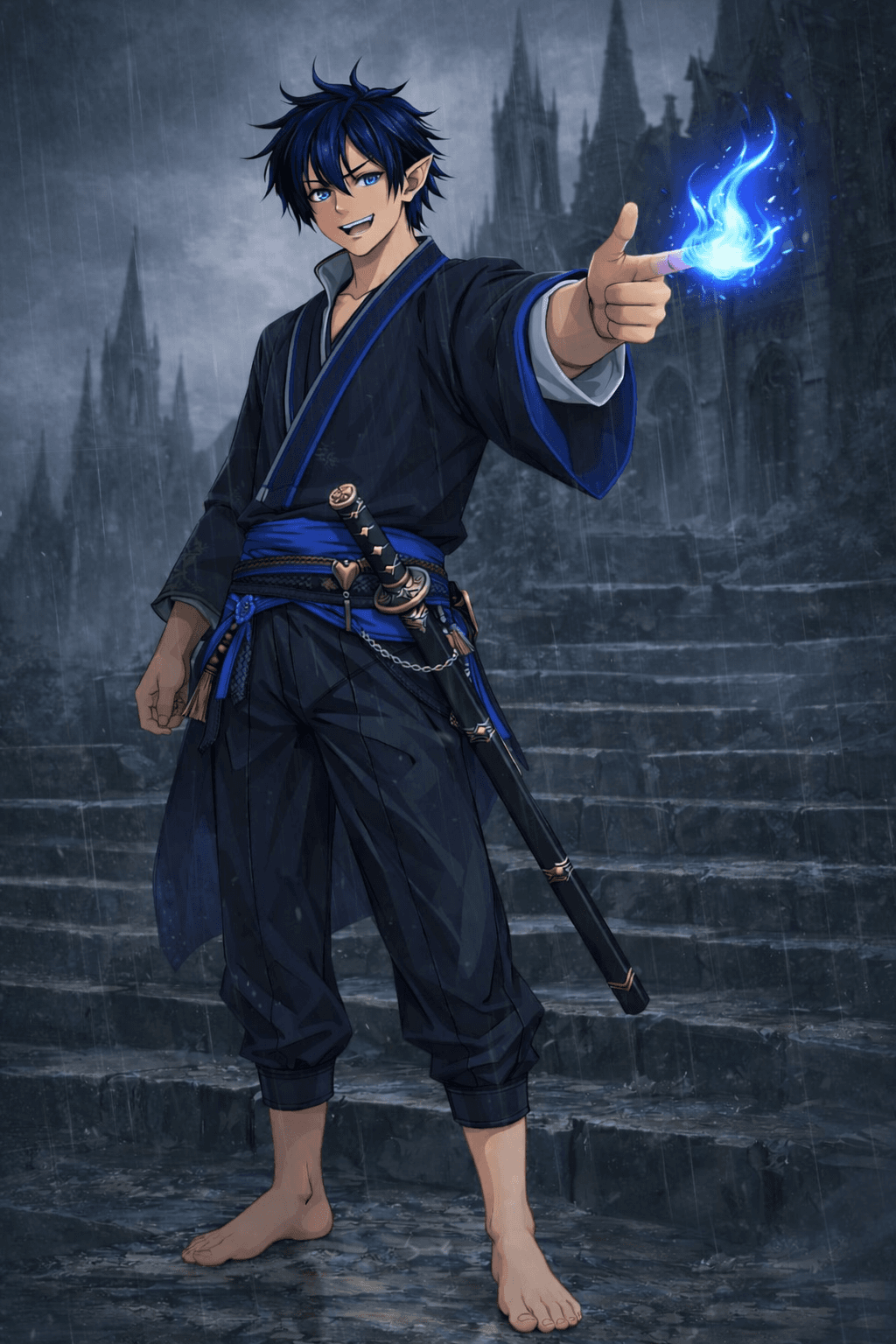
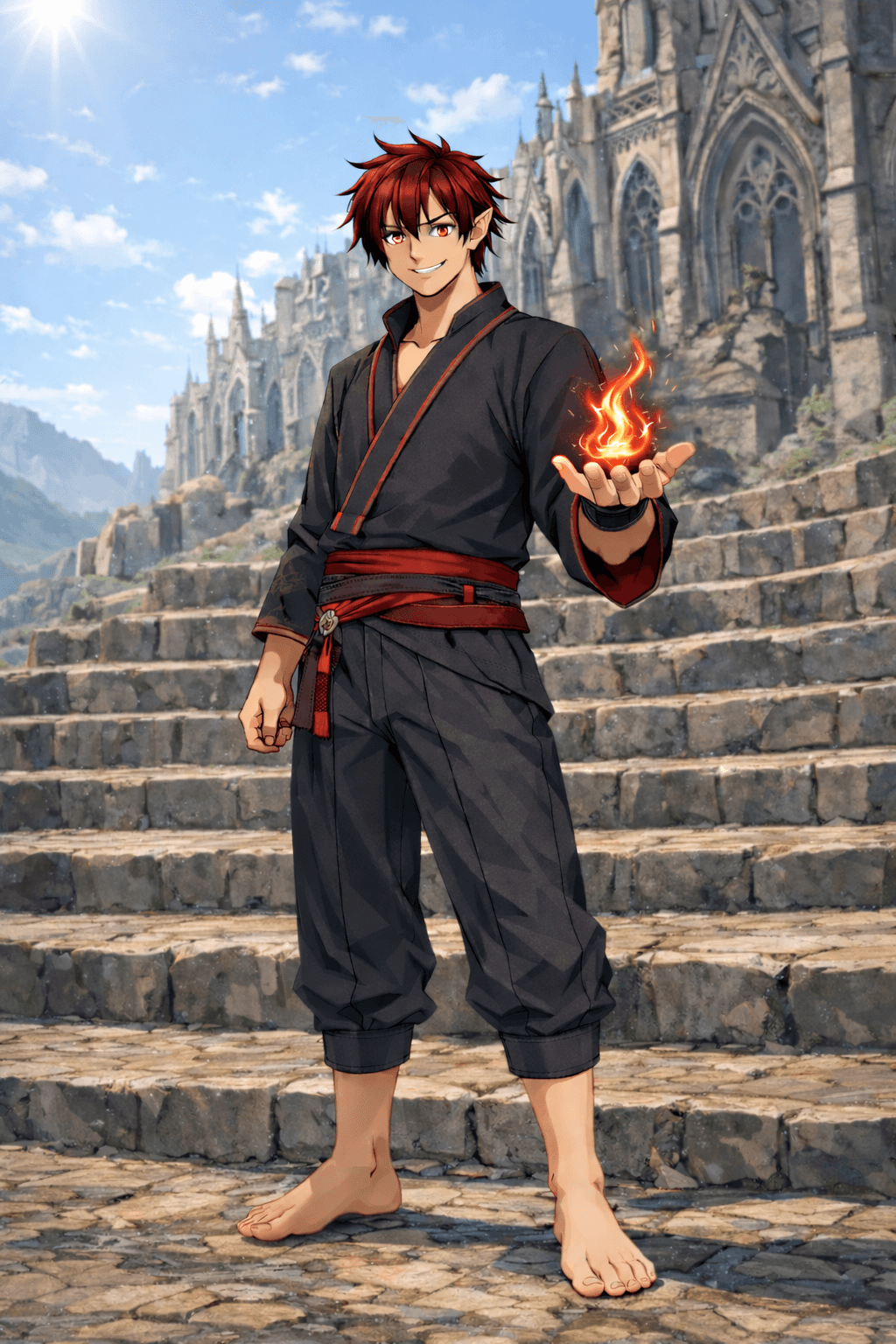
Prologue 9: best friends part I
Drill Yard of the Hiroshima Military Base (Aki Province) — Morning of Late Summer of the Year 1718
Fifteen Years After the Disappearance of Seijuro Nakata
Some things are not taught. They are inherited.
That maxim could have been signed without a blink by any weapons master at the Hiroshima barracks that summer of the year 1718; they would have signed it without quite knowing what they were signing. For two cadets were finishing in that yard the final cycle of their training, and they were finishing it the way one finishes things that have been too long in the finishing: without visible effort. Thirteen years after that dawn when a boy from the orphanage of the southern district vaulted the wall to enlist on his own, and thirteen years after another boy, identical in stature, had been deposited by his grandfather in the fourth position of the line — the two boys were still doing everything together, with the same economy of gesture. They were two young men now. You could see it in their shoulders, broad on both from seasons of carrying loads; in their hands, knuckles weighted with old scabs; in their jaws, hard. But they were still those two children from the mess hall of the first day.
At six in the morning, the yard filled with cadets of the senior class — eighteen, twenty, some twenty-two — preparing for the regulation weighted run. The two small ones from before, no longer small, would leave first and come back first: three ri (about thirteen kilometers) with a pack on the back, four laps around the inner perimeter, an eight-chō sprint (about 800 meters) at the end. That morning, as on almost every morning for the past three summers, Nakata and Ren came into the final stretch talking.
Talking.
Like two old men keeping count of the price of rice.
The drill corporal of the west wing, a square-built young man who had been at the base barely two years, turned when he saw them coming and shook his head with a mixture of poorly hidden admiration and professional anger. Behind the two of them, fifteen ken (about thirty meters) back, the fourth in the platoon — Yoshida, a tall boy from the Aki district — had his tongue out and his pack sinking his right shoulder. Behind the fourth, thirty ken (about sixty meters) back, the rest. Behind the rest, a chō (about a hundred meters) back, the fallen ones in a crouch on the sand, hands on knees, breath broken.
Nakata crossed the line with the long stride of someone who has never truly pushed. Ren, half a body in front, did the same. They dropped their packs at the same time — plop, plop — in the unloading square at the eastern wall, and Nakata still had air left to finish the sentence he had begun in the last ri:
"…that the one from the east found out late."
"The one from the east always finds out late," Ren answered, also without panting. Then he crouched by the well in the corner, drew up a ladle of water, drank, and passed the ladle to Nakata.
Three senior cadets watched them from across the yard.
One of them clicked his tongue.
Another laughed without mirth.
"Look at the brats from the barracks," the third said in a low voice, as if praying against bad luck. "They've just done three ri with a regulation pack and the silver-haired one — his hair hasn't even gotten wet on the inside."
It was true. The white-silver streak that showed under Nakata's military cap was still dry at the root: the hair came out dark with sweat at the tips, but the roots kept that unmistakable tone he had worn since the day he was born. His red eyes — deep red, like his father's — were calm. His jaw was relaxed. His knuckles, white but not trembling. Three ri had passed over him the way wind passes over a cedar: without bending it.
Beside him, Ren drank. Three ri had left him exactly as Nakata: breathing deep two or three times, recovering his rhythm in less than half a minute, ready to set out again if anyone asked.
Captain Hayato Inoue came around the back of the barracks block with his small dark-wood baton tapping softly against his left palm — toc... toc... toc. Fifty-four years old. Shoulders still broad. Square face that had spent thirty years receiving cadets in this same yard. When he saw the two young men at the well, the baton paused for an instant.
Only an instant.
Then, without speeding up and without slowing down, he kept on toward the administrative wing with one toc exactly every two steps.
But to Yoshida, when the tall boy from Aki crossed the line fifteen seconds after the two small ones, Inoue gave the long look an instructor reserves for the cadet who arrived late.
"You don't learn on your knees," he said, without raising his voice. "On your knees a man stands up and keeps going."
Yoshida stood up.
And kept going.
Nakata and Ren did not turn to look. They had spent thirteen years not turning to look.
Mess Hall of the West Wing of the Hiroshima Base, Midday
The mess hall of the west wing had four long tables of dark wood and a whitewashed wall at the back. The table farthest from the wall — the one where the trays leaned against each other at the edge, like two boats moored to the same dock — was the one they had been occupying since the first day. Thirteen years of trays. Thirteen years of pickled daikon and white rice with a piece of dried fish. Thirteen years of Ren's right hand carrying the chopsticks and his left hand resting flat on the table, exactly as he had learned the first morning of the first year.
That midday, Nakata pushed the daikon to the left of the bowl with his chopstick, picked it up, chewed it twice, swallowed.
He set down his elbows.
He looked at Ren.
"Tomorrow."
"Tomorrow," Ren answered, without looking up from his bowl.
Thirteen years was enough for that single word to mean exactly the thing it had to mean.
It was the promotion examination. They had had it on the calendar since spring. The barracks council had summoned them both — and eighteen others — to present themselves at dawn the following day in the great courtyard. The exams were no longer what they had been when Seijuro the father took his, in 1690, at sixteen. Back then a superior would come from Edo, Captain Fujibayashi in his case, and put you to the test: he would watch you fight, watch you shoot, watch you fall and stand up. It was an old, simple system. You passed if the superior said you passed. And Seijuro the father had passed with a single left fist to the jaw of Captain Fujibayashi himself — an image still told at the Hiroshima barracks the way an old fisherman tells of the catch that took him three days.
But times had changed. The general staff in Edo had decided — for some fifteen years now — that promotion exams should be among candidates. That cadets should measure themselves against one another. That it should not be the eye of a veteran but the clean result of a series of trials, compared with the results of the others, that would decide who climbed a rung in the military hierarchy of the archipelago. And it had been decided also, for economy and for hardness, that from each exam only one would pass. Only one promoted per round. Four or five days of elimination trials, the top two on points to a final hand-to-hand combat without weapons, and the one who won that combat moved up. The one who lost did not. The others, neither.
Twenty candidates.
A single seat.
"Your father passed at sixteen," Ren said, chewing the rice. "Your grandfather at seventeen and a half."
"I know."
"We're doing it at eighteen."
"I know."
Ren smiled that very small smile without showing his teeth, made by a child who had learned to smile late and who at eighteen still smiled the same way. Black hair cut short, round brown eyes. His cheeks, no longer a child's, kept nonetheless a remnant of the old softness, as if Ren had not quite wanted to let go of the face of the boy from the orphanage of the southern district.
"We're slow."
Nakata, who had been chewing the daikon, nodded once.
He nodded twice.
"We're slow," he repeated.
They both knew they were not slow. But they both knew, too, that in House Nakata, to say one is slow is a sober way of saying one is well. To speak too soon, in House Nakata, had always been almost a second form of obedience: not to puff oneself up, not to say more, always to arrive early at the place where one had to be. Ren had spent thirteen years learning that borrowed language, with no grandfather, no back yard, no smooth flat stone. He spoke it now as if he had drunk it in with his mother's milk.
"Only one passes," Ren said, without looking at Nakata.
"Only one passes."
"Out of the twenty."
"Out of the twenty."
"The top two on points fight at the end."
"I know."
There was a silence. Nakata's chopsticks held still. Through the open window of the mess hall came the noise of the main courtyard, which the cooks were emptying at that hour; far away, far below, the bell of the southern district market was striking twelve. Thirteen years of bells. Thirteen years of meals. Thirteen years of daikon at the far end of the wall.
Ren took the last piece of fish from his bowl, cut it in two with his chopstick, and passed half to Nakata.
"If I end up fighting you, I won't hold anything back."
"If I end up fighting you, neither will I," Nakata said.
And then, without looking at each other, they both smiled as if they had closed a deal.
Although neither of them said it aloud, both of them knew perfectly well — since before crossing the gate of the mess hall that morning, since before the spring summons even — that they were going to have to fight each other at the end of the exam. They knew it the way one knows inevitable things: without arguing them. Thirteen years had seated them, meal after meal, at the far end of the wall. Thirteen years were going to set them, with a promotion in the middle, face to face.
But four days were still left.
Four days were still left.
And still, for that afternoon, they could eat daikon together as if the fifth would never come.
Great Courtyard of the Hiroshima Base, Dawn of the First Day of the Exam
There were twenty of them. They stood in a double line beside the flagpole of the great courtyard, the cold breeze from the east moving the skirts of their tunics. The class of 1690, the class that had lived through the first year of the return at age ten — for almost all of them had been born in 1690 or very near it — and two boys from 1700, plainly advanced for their age, were taking the exam that morning of late summer in 1718. Hayato Inoue, fifty-four years old, square face, baton in his right hand, walked in front of the line with the professional ceremony of a man who had made that same round each year since before any of the twenty had been born.
"The first trial," he said, tapping the baton twice in succession against his left palm, "is endurance. Thirteen ri (about fifty kilometers). Five hours maximum."
There was a minimal movement in the line. Not a murmur: a movement. Five hours for thirteen ri was the exact mark of a trained soldier. No cadet trained at this barracks should have any trouble. And yet, it was already plenty.
"The course leaves the main gate, climbs to the crest of Futaba by the east path, descends to the harbor, returns by the coast, and closes by the west path. Thirteen long ri. There will be three watering stations."
A pause.
"But the trial is not finishing. The trial is your placement. Twenty points to the first. Nineteen to the second. And so on. The last one across the line gets one point. Whoever does not finish, none." The baton sped up: toc-toc-toc-toc. "And whoever finishes fifth, fourth, third, or second still has four days left to gain or lose points. This is the first trial. Not the last."
A second pause.
"Departure in five minutes."
Nakata stretched his shoulders. Ren, beside him, did the same. The regulation pack had been removed from both of them for this trial: only short tunic and reinforced boots. Nakata laced the left boot first and the right after — a superstitious habit inherited which at that moment he did not even identify as inherited — and stood up. Ren, who had spent thirteen years watching him, did exactly the same, in the same order, without anyone agreeing on anything.
Five minutes later, the twenty went out the main gate and turned right onto the east path.
The first two hours, Ren set the pace from the head of the group. It was not a runaway pace: it was a stubborn, solid pace, without variation. The stride of a man who does not tire because he does not quite understand what tiring is. Nakata, who did understand what tiring was — for he had spent more years training with weight, with sword, and with rifle than with empty legs — held to fifth place from the first ri. Fifth was enough for him. Fifth was not victory, but fifth was sixteen clean points. And sixteen clean points on the first day were a reasonable cushion against the days to come.
Around the fifth ri mark, on the climb to the crest of Futaba, two cadets dropped off. Aki — Yoshida — already had his tongue out and a broken stride. Another, younger, vomited at the side of the path and sat down.
Ren did not look back.
Neither did Nakata.
At the eighth ri mark, after the first watering station, the head group split in two: Ren ahead, alone, with a clean two ken (about four meters) of distance. Behind him, in a block, second through fifth, with Nakata closing the block and saving exactly the energy he knew he was going to need tomorrow to squeeze the trigger of the carbines.
"You're doing fine," Ren shouted to him, without turning his head, in one of the few sentences he spoke in five hours.
Nakata did not answer.
He had too much concentration in his quadriceps.
Ren crossed the line at four hours and two minutes after dawn. Nakata, at four hours and eleven. Between Ren and Nakata, the second, third, and fourth crossed in quick succession: none of the three was more than a minute six behind Ren. The sixth came in at four hours and eighteen. The seventh, four hours and thirty. The last one to cross within the time limit did so at four hours and fifty-seven. Three did not finish.
Seventeen candidates standing at the end of the first trial.
Three out.
Inoue, beside the flagpole, recorded the placements without raising his voice. Toc... toc... toc.
Ren, first, twenty points.
Second, nineteen.
Third, eighteen.
Fourth, seventeen.
Nakata, fifth, sixteen.
"Tomorrow at dawn, shooting range at the east wall," Inoue said, without elaborating. "Regulation carbines. Twenty-one rounds per candidate. Kit at five."
And he walked away across the gravel of the yard without turning his face, tapping his left palm with his baton: toc... toc... toc.
Behind the flagpole, without Inoue having quite watched, Ren gave Nakata a light bump with his elbow.
"Tomorrow's yours."
"Tomorrow's mine," Nakata answered.
Shooting Range in the Northern Forests, Morning of the Second Day
The shooting range at the east wall was used for daily training. But the shooting trial of the promotion examination — since the last reform of the general staff — was held outside the barracks, in the cedar forest on the northern flank of the base, where the terrain was uneven and the thickness allowed targets to be hidden as if they were akuryō in ambush. It was a trial designed by those who had written the reports of the first years of the return, those who had seen what they had seen in Wakayama, in Edo, in the west of Nagoya. It did not measure only shooting. It measured discrimination.
Hayato Inoue, beside a field table covered with rounds in rows, explained it without preamble.
"The course is half a ri (about two kilometers). There are fourteen targets distributed along the route. Some are gray and rise for half a second: they simulate akuryō in a wave. They have a head and a heart painted on them — both red — to mark the lethal points. Only shots to the head or heart count. Shots to the leg, arm, belly, or anywhere else they please, do not count."
A pause.
"The other targets are civilian. You will identify them by the color: white kimono with a blue sash. You do not shoot them. If you shoot them, we deduct five points per civilian struck."
The baton stopped.
"Twenty-one rounds. Fourteen targets. You have seven rounds of margin. Use the seven that are left over with your head. There are civilians who rise at the same time as the akuryō in front of them, and akuryō behind the civilian, and akuryō standing still at thirty ken (about sixty meters) while three more leap up at one and a half ken (about three meters). The course is run on the move. The clock starts on the first shot."
Here, Inoue did look at the line.
"I do not want to see any cadet shoot a woman painted in white in the chest. Do you hear me?"
"Yes, sir!" the seventeen answered.
Nakata was not unsettled by that. What unsettled him — but only in a focused way, not a nervous one — was finishing as high as possible. The regulation carbine of the Hiroshima barracks, light, with two short magazines, was a weapon he had handled since he was seven. He had spent eleven years pulling the trigger of that same model. He had in the bones of his right forearm the memory of the recoil. He had in his left cornea — the shooter's eye — the ability to read an akuryō at two chō (about two hundred meters) the way others read the characters on a sign. And he had, since the age of twelve, the historic record of the barracks in two-handed shooting.
Ren, by contrast, was a little uncomfortable with firearms. Not very. Just enough.
"Shoot your way," Nakata said in a low voice, before the start.
"What? Come on, Nakata! You know I'm no good with firearms, what kind of shitty advice is that!?" Ren answered, half laughing.
"Just imagine the weapon is an extension of your own arm. It'll help you aim better if you see it that way," Nakata advised, just before the whistle that signaled the start of the trial.
"An extension of my own arm, you say? Like it's my own limb? All right, I'll try," Ren finally answered, thoughtful, turning over in his head the advice his best friend had just given him.
They went out one after another, three minutes apart between candidates. Nakata went out sixth, after the five from the previous day; Ren went out first, by the position he had earned in endurance. The rule of inverse order from what was expected in each trial was, they said, an inheritance from the old exams of the general staff: that the strongest in one thing should start the least strong in the next.
When Nakata entered the course, the forest already smelled of old gunpowder.
He ran.
Target one — gray akuryō at thirty ken (about sixty meters), peering between two cedars. Shot. Heart.
Target two — civilian in white with a blue sash at fifteen ken (about thirty meters), in the middle of the path, arms extended as if asking to pass. No shot. Keep running.
Target three — akuryō at eight ken (about fifteen meters), lateral exit on the left, half-second leap. Clean shot. Head.
Target four — akuryō at fifty ken (about ninety meters), on a slope. Bracing on a rock, the cadet corrected the barrel. Shot. Head.
Target five — civilian in white kimono peeking out behind an akuryō; the akuryō leaped in front at six ken (about twelve meters). The akuryō target covered half the civilian's target. If Nakata shot in haste, he could pass through the akuryō's head and graze the civilian's shoulder. Nakata took a single breath. Waited half a second. Fired at the correct angle: the round entered through the akuryō's temple, came out the other side, and buried itself in the cedar, far from the civilian.
Clean head.
Civilian intact.
Target six — two akuryō at once, fifteen ken (about thirty meters), simultaneous exits to the left and right. Shot. Shot. Head and heart.
Target seven — civilian with blue sash half a ken (about a meter) off the path, crouched, surprise. No shot. Keep going.
Target eight — tall akuryō, one chō (about a hundred and twenty meters), fixed position. Bracing on the ledge of the stone wall, the cadet took two seconds. Aimed. Fired. Heart at one chō. The gray akuryō fell forward with the target painted in red on its chest.
Target nine.
Target ten.
Target eleven.
By target twelve, Nakata had fired twelve rounds. He had hit twelve. He had not touched any civilian. He had nine rounds left in the two short magazines.
Target thirteen — three akuryō simultaneous; one at one and a half ken (about three meters) from the path, another at five ken (ten), another at twenty-five (fifty). Here Nakata had to decide. If he shot the closest first, the ones at five and twenty-five ken would have him in their range. If he shot the farthest first, the closest would have eaten his head. Nakata shot the closest in the head — half-turned, almost without looking — and, without finishing the turn, fired two shots at the one at five ken — head, heart — and a third at the farthest — heart. Four shots. Three targets.
Target fourteen — civilian, white, in the middle of the path, with an akuryō peering its head over the civilian's shoulder. The trap of the akuryō hidden behind the civilian. If you shoot the akuryō in the head, the trajectory passes through the civilian. If you don't shoot, the akuryō devours the civilian. Nakata moved one and a half ken (about three meters) closer, leaned to the left, opened the angle, and aimed over the civilian's shoulder.
He fired.
The akuryō fell.
The civilian was untouched.
Nakata crossed the finish line without losing his breath.
Inoue, who timed the run from the judge's hut, recorded: fourteen targets, fourteen lethal hits, no civilian touched. Time: four minutes and eleven seconds. The best time on file at the barracks since records were kept. Inoue tapped the baton twice on his palm. Twice, no more. And went on writing.
Ren came in sixth. Eleven targets struck, fourteen impacts — for there were targets that had been hit by putting two shots where others had put one — no civilian touched, time of five minutes and fifty seconds. It was not a bad placement. But Ren was not a prodigy with firearms, and the trial was designed to reward the prodigy.
Nakata: first. Twenty points.
Ren: sixth. Fifteen points.
Added to the previous day, the tallies that Inoue laid out on the field table left no room for surprise: Ren, thirty-five. Nakata, thirty-six. Ahead of the two of them, no one. Behind the two of them, a great deal of distance.
"Tomorrow, weight room of the south wing. At dawn."
Inoue closed the notebook.
Toc... toc... toc.
And he walked off down the barracks path while behind his back, without him seeing, Ren laid an open palm on Nakata's right shoulder for an instant.
It was the only gesture. But it was.
Weight Room of the South Wing, Morning of the Third Day
The weight room of the south wing was a long, low-ceilinged hall, with two bench-press stations and two squat racks at each end. The bars were the regulation ones of the general staff: Olympic iron bar, cast-iron plates, short-lever clasps. The light came in through the high small windows of the east wall. It smelled of iron, of old sweat, of chalk.
Inoue came in at six on the dot, with the baton and a new notebook under his left arm.
"Two trials," he said. "Bench press. One repetition. Then squat. One repetition. Each man chooses the weight he believes he can lift. If you fail the rep, no points. If you push it up clean, the weight is recorded. Whoever lifts more kan wins. Whoever lifts less wins less. Twenty points to the first. Nineteen to the second. And so on."
A pause.
"If you choose too little weight for fear of failing, you're not going to add up. If you choose too much and fail, you're not going to add up. This is not just a trial of physical strength but of knowing how to recognize the strength each man has. Calibrate."
The baton struck twice, dry.
"Departures in inverse order from yesterday's placement. Yesterday's last lifts first."
That rule — the twenty candidates thought at the same time, without saying so — was cruel. It meant that the first to lift did so without knowing the weight the others would put on, without a point of reference. The last, by contrast, would lift knowing exactly how much was enough to set themselves ahead.
Ren, sixth from the previous day in marksmanship, would lift seventh. Nakata, first from yesterday, would lift last.
One by one, the repetitions went down. The youngest put up twenty-two kan (about eighty kilos) and pushed them up with extreme effort. The next put up twenty-four kan (ninety kilos) and pushed them up cleanly. The third, twenty-five kan (about ninety-five kilos), pushed them up with his back arched badly, and Inoue marked an asterisk — deficient technique, but valid. The fourth put up twenty-seven kan (about a hundred kilos) and failed at the third of the lift; zero points. The fifth, twenty-five kan (about ninety-two kilos). The sixth, twenty-seven kan (about a hundred and two kilos).
When it was Ren's turn, the room was in silence.
Ren walked up to the bar, looked at the plates for an instant, and signaled to the assistant: thirty-three kan (about a hundred and twenty-five kilos).
There was a movement on the next bench.
Thirty-three kan for an eighteen-year-old cadet was a veteran officer's weight. Inoue himself, in his best year, had lifted thirty-two kan (a hundred and twenty kilos). Thirty-three kan was a brute weight, the weight of a grown man who had trained a whole life.
Ren lay down.
He took the bar.
He brought it down to his chest with his breath held.
And he pushed it up.
He pushed it up the way a bakery boy hoists a sack of rice on his shoulder: with his back straight, his face without theater, his elbow clean. Cast-iron plates of four kan (fifteen kilos) a side and rings of just over a kan (about five kilos) on top. The bar settled on the supports with a brief metallic clang. Ren sat up. He adjusted his tunic. He stepped off.
Inoue recorded: Sato Ren, thirty-three kan, valid.
After Ren came more candidates. None passed one hundred and ten.
When it was Nakata's turn — the last, by his first place from the day before — the room watched with a different attention from the one it had given the others. Nakata was not the strongest of the class. They all knew it. He knew it. Inoue knew it, having crossed paths with the silver-haired cadet in the yard for years and recorded him in his monthly reports: absolute prodigy with weapons, complete soldier in everything else. But pure strength was not his thing. His thing was the hand.
Nakata walked up to the bar, looked at the plates, calculated.
He asked for thirty kan (a hundred and twelve kilos).
Thirty kan was the fourth-best weight of the day. Below Ren — thirty-three kan — below the second's thirty-two, below the third's thirty-one. But above the rest. Thirty kan was, at that exact moment, the weight Nakata knew he could push up clean without failing.
He was not going to risk failing.
If he failed, he lost the cumulative first place of the exam.
And the cumulative first place mattered to him. Thirty kan gave him fourth if his calculation was right and points enough to keep the lead. He did not want to win the trial: he wanted to add up.
He calibrated.
He lifted.
The bar went up without a tremor. Inoue recorded: Nakata Seijuro, thirty kan, valid.
The bench press closed like that: Ren, first. Nakata, fourth. The squat, afterward, gave a similar result: Ren put up forty-eight kan (a hundred and eighty kilos), pushed them up with his back like a mast, first. Nakata put up forty kan (about a hundred and fifty-two kilos) — fourth again — pushed them up clean, added up.
End of the third day.
Cumulative tally for days one, two, and three:
Ren Sato: fifty-five.
Nakata Seijuro: fifty-three.
The third, eleven points behind.
"Tomorrow at dawn, central yard," Inoue said. "Each man with the weapon he chooses. Combat against the instructor of that weapon. The better you fight, the more points. If you defeat the instructor, maximum score."
He closed the notebook.
He turned around.
And before going out the door, without turning back, he added a single sentence.
"Choose the weapon well."
Toc... toc... toc.
He left.
Central Yard of Arms, Morning of the Fourth Day
The twenty candidates presented themselves at six. At the back of the yard, behind the flagpole, there was a row of weapons laid out on a long table: two combat katanas without edges, of hard wood, a pair of sasumata, three jutte, a kanabō of forged iron four shaku (about a meter twenty) long, two short spears, a pair of combat knives, a naginata. Each weapon had its instructor behind it, seated in the seiza position on a mat. Twenty candidates, eight instructors — some would cover several weapons if no one chose theirs. The rule of the exam was simple: the candidate chose. He fought. Inoue scored.
Nakata walked up to the table.
He passed his gaze over the two katanas.
He chose his.
He chose the katana.
It is worth pausing here for an instant, because the gesture matters more than any of those present, in that moment, understood. Nakata had been born for firearms: at seven he had braced his first light rifle on the straw bag of the shooting range at the east wall; at twelve he had broken the barracks record in two-handed shooting; at fourteen he was already the best young marksman west of Kyoto. A throwing knife in Nakata's hand was a shot without gunpowder. A carbine, an extension of his forearm. He had specialized in the modern.
But before firearms — before even the small ones' barracks block — was the smooth flat stone of the back yard of Mount Futaba. The smooth stone where the great-grandfather of Jirōbei's great-grandfather had built the house, where four generations of Nakata had learned to draw before the adversary's eye finished blinking. There was the notebook with covers of black cloth, inherited by male child. There was old Honda, thirty years correcting the angle of the high cut. And there was the canonical sentence of the barracks about the silver-haired cadet at fourteen: This boy has nothing more to learn from me.
Through Nakata's blood ran the blood of four generations of katana.
Not by his own choice: by blood.
He chose the katana without speaking of it to anyone. He gripped the hilt with his right hand high beside the tsuba and his left low at the end of the tsuka — the classical two-handed grip, the grip his grandfather had taught him at four on the smooth stone — and walked to the mat at the back.
The instructor of the katana for the exam was not Honda. Honda had been retired for two years to the village nearby, after a fall on a staircase in the winter of 1716. The instructor was a veteran brought from the Edo base: forty-six years old, tall, gray hair gathered in a low topknot, sharp face, small eyes. His name was Kano. He had been in charge of testing the western candidates for five years now. No one in Hiroshima had defeated him. Three had drawn with him.
Kano stood up from the mat, bowed.
Nakata bowed.
They took their guards.
The combat lasted less than forty seconds.
Kano opened in gedan — the low guard — and attacked from the right, in a rising cut aimed at Nakata's left wrist. Nakata deflected the cut outward with a wrist twist that four generations of Nakatas had polished on the smooth stone. Kano, who expected the twist, redirected the blade toward the neck: horizontal cut at mid-height. Nakata lowered the katana, raised it on the slant, stopped the cut in the last quarter of its trajectory, and used the half-beat pause of the adversary to bring the edge to his left flank and feign — for it was an exam, not death — the side cut.
The wooden blade touched Kano's left flank.
Kano held still for half a second.
Then he let go of the katana with one hand.
He bowed his head.
"Well done," he said, and his voice sounded the way the voice of an Edo instructor sounds when, without enthusiasm and without bitterness, he acknowledges that a provincial cadet has just given him a real fight.
Nakata bowed. He returned the katana to the mat. He walked to the side of the yard without raising his eyes.
In his head, without meaning to entirely, the rough voice of his grandfather sounded, on a morning fourteen years ago, on the smooth stone of the back yard: Don't wait for the cut. Reach him first. The Nakatas had never been famous for talking much during training. But the four sentences his grandfather had repeated over the years Nakata carried engraved like cedar leaves on the floor of his head. That morning, without quite knowing why, he had used them all.
Inoue, beside the flagpole, recorded: Nakata Seijuro, katana, victory over the instructor. Maximum score for the trial.
Twenty points.
Ren walked up to the table afterward.
He did not look at the two katanas. He did not look at the sasumata, or the jutte, or the spears, or the knives. He did not look at the naginata either. He looked at the kanabō.
The kanabō was an ugly thing. A club of forged iron, four shaku (about a meter twenty) long, with blunt studs all over its head, very heavy, made to crush armor and bone, not for fencing. It was the least chosen weapon on the table. No one had fought with it in the exam for years.
Ren picked it up with his right hand the way one picks up a dry stick.
He shifted it to two hands.
He spun it once over his head to feel the weight.
And he walked to the mat at the back.
The instructor of the kanabō was a big man from the local base, a former dock loader, who had built his military career on brute strength. Fifty-three years old. Neck like a barrel. Hands the size of bowls. His name was Goto. He had spent nineteen years undefeated on that mat.
Goto stood up.
He took the other kanabō.
They bowed.
It began.
Combat with the kanabō is not elegant. It is blow against blow, force against force, weight against weight. Goto opened with a side swing toward Ren's right flank; Ren parried two-handed, stepped back, answered with a vertical swing from top to bottom. Goto covered horizontally above his head. The two clubs collided with a dull clang that echoed all the way to the mess hall of the west wing. The second blow came from Goto to the left shoulder; Ren parried again, but this time he did not step back. He held his ground. And on the next motion, he did what Goto did not expect to see in an eighteen-year-old cadet.
He pushed.
He pushed with both hands against the opposing kanabō.
Ren was eighteen years old and had a clean thirty-three kan (a hundred and twenty-five kilos) in the bench press. Goto was fifty-three and had the broad waist of a man who had carried fifteen thousand sacks of rice in his life. The brute strength of the two men was measured, for exactly two seconds, at the crossing of the two iron clubs. Then, without sound, Goto's right elbow gave by a centimeter.
And a centimeter was all Ren needed.
He released the cross, spun the club to the left, brought the head of the kanabō to Goto's flank and stopped a hand's breadth away — for it was an exam, not death — from crushing his lower ribs.
Goto held still.
He let go of the club.
He bowed his head.
"Well done, boy," he said, and to Goto, who had only learned to lose with dignity after forty, it cost him very little that morning to say it.
Ren bowed. He returned the kanabō to the table. He walked to the side of the yard.
Inoue recorded: Sato Ren, kanabō, victory over the instructor. Maximum score.
Twenty points.
When the fourth day closed, the tallies were what they had to be. Of the twenty candidates, eighteen had fought well but none had defeated the instructor; the points distributed ran from seventeen down to ten. Only Ren and Nakata had added up the maximum. Ren, seventy-five points in four days. Nakata, seventy-three. The third place, twenty-one points back.
"The trials are over," Inoue said at the end of the day, without solemnity. "Tomorrow at dawn the top two on points are announced. Those two will fight hand-to-hand, without weapons, until one of them surrenders. The one who wins moves up. You may withdraw to your dormitories. Tomorrow at dawn, great courtyard."
He left.
Toc... toc... toc.
Behind his back, without him turning, the twenty cadets were already closing ranks, but Nakata and Ren caught each other's eye for an instant.
Only an instant.
And they both knew, without saying it, what they both knew.
Junior Officers' Dormitory of the North Wing, That Same Night
The junior officers' dormitory had eight cots lined along the two long walls, with a wooden screen between each pair. Nakata and Ren had been sleeping in the same screen for three years. Nakata's cot against the east wall. Ren's cot against the wall opposite. A high small window between them. Thirteen years almost continuous, sleeping with one and a half ken (about two and a half meters) of air between their heads.
That night, when the lamp in the corridor went out, Ren fell asleep with the ease of a bakery boy at the end of a day of carrying. He fell asleep even a little before he had quite lain down, Nakata thought; he heard him breathe slowly the way things that are not questioned breathe.
But Nakata did not fall asleep.
He did the math.
Seventy-five. Seventy-three. The difference between first and second on the exam was two points. Behind the two of them, at twenty-one, all the rest. In any pending trial — if there were one left — the distance to the third was unrecoverable. And ahead, there was nothing now. Only the hand-to-hand combat at dawn.
It was a clean calculation.
Tomorrow they would go out to be announced.
Tomorrow Ren and he would go out.
Tomorrow they would fight.
Nakata stayed for a while looking at the ceiling of the screen. It was cedar wood, like the stone of the back garden of Mount Futaba. Four longitudinal beams crossing it, one transverse in the center. Thirteen years counted. As many times as the ceiling of the small ones' barracks block.
Thirteen years.
Suddenly he did a different sum.
He had met Ren at five. They had eaten daikon together at five. They had bled together in the first push-ups at five. They had taken the first short katana wrapped in white cotton from Honda at six. They had pulled the first trigger at seven. They had marched together five ri (about twenty kilometers) at eight. They had held the first light rifle at nine. They had hunted the first full-body target at ten. They had run the first live-fire simulation in the northern forests at eleven. They had marched ten ri (about forty kilometers) with regulation pack at twelve. They had fired live ammunition at fourteen. They had risen to patrol officers at sixteen. They had spent two years on long patrols. They had slept all those years with two and a half meters of air between their heads in this dormitory or in another one identical beside it.
Thirteen years.
We'll train together and we'll go to where your father went.
The sentence rose in his head without warning, with exactly the tone and the vocabulary of that five-year-old boy in the mess hall on the first day. Nakata had not remembered it for a long time. He rewound it in his head twice. Ren had said it. Ren had kept it for thirteen years. Ren did not yet know — and Nakata was not going to tell him, for his grandfather kept saying that he was not yet ready to know it fully — where exactly his father had gone. But Ren had walked every day as if he knew.
Nakata shook his head once.
He went back to the calculation.
Tomorrow. Tomorrow he and Ren would go out to the great courtyard.
How did one beat Ren?
He thought it through slowly. Hand-to-hand, Ren was a very difficult thing. Not by technique — Ren was no prodigy in technique — but by physics: by build. Ren did not tire. It was the central trait of his friend from the first day in the yard. He's my own age. He's never trained. And he holds out at what we who have trained do. That assessment from age five was still, at eighteen, the operational assessment of cadet Ren Sato. He had no physical ceiling. Almost infinite endurance. Strength above the average of his class — thirty-three kan in bench press, forty-eight in squat, beat the kanabō instructor by hand. Stamina.
And, above all, he did not give up.
He had never given up.
Not the first morning, bleeding from his knee and having vomited twice and fallen four times and completed all the exercises. Not when they caught him with thirty-eight degrees of fever on a march at fourteen and he kept marching without asking to be relieved. Not on the patrols of 1716, when the cold of the north cracked open his hands and he kept loading the rifle. Ren, in hand-to-hand, was a machine. His fists did not hurt him. His legs did not weigh on him. If the combat lasted half an hour, he could last half an hour. If it lasted an hour, an hour. If it lasted all day — Nakata was sure — Ren would last all day.
Nakata would not last all day.
Nakata was fast, agile, ingenious, technical. He was a prodigy with weapons. He was also a prodigy at hand-to-hand — Captain Inoue's patrol reports said so: hand-to-hand notable, no defined style, with natural instinct. But he was not a machine. He had a physical ceiling. He had quadriceps that tired. He had lungs that asked for air. He had knuckles that hurt after striking the bag thirty times in a row.
How did one beat a machine?
You beat it with your head.
You beat it by hitting a machine before the machine realized it was being hit.
But Ren was not so dumb as not to realize.
Ren had spent thirteen years learning Nakata's gestures the way Nakata had spent thirteen years learning Ren's. Nakata's speed, Ren knew. Nakata's technique, Ren knew. Nakata's capacity to anticipate, Ren knew. What Nakata might do tomorrow in the great courtyard, Ren was going to see coming.
Almost everything, he was going to see coming.
Almost everything?
Nakata stayed looking at the ceiling.
And what he himself did not know he was going to do?
He thought about it. He gave it another turn. He gave it another. He gave it another. The idea did not close. When it came to the only friend he had had in thirteen years, calculations slipped through his fingers. To think about Ren was to think about a brother. To think victory against Ren was to think a betrayal of something that had gone for thirteen years without a name. His head got stuck on the sentence from the mess hall on the first day.
If I end up fighting you, I won't hold anything back.
If I end up fighting you, neither will I.
Nakata took a deep breath.
He closed his eyes.
He opened them again.
He had spent almost two hours turning it over. No plan came to him. Fragments came: start strong, tire him out, dodge him, make him doubt, wait for the second-round fatigue… but every fragment crashed against the same wall: Ren did not tire. Ren did not doubt. Ren did not give up. And Nakata, against that wall, did not bring stone enough.
He closed his eyes again.
He fell asleep without having resolved anything.
The last thing he heard, on the edge of sleep, was Ren's deep, calm breathing on the other side of the screen, one and a half ken of air between the two heads, exactly like the first night of the first year. Thirteen years.
And tomorrow, at dawn, they would walk out to the courtyard.
And they both knew what they knew.
But not yet.
Not yet.
They still had the night not to know it fully.
Great Courtyard of the Hiroshima Military Base, Dawn of the Fifth Day
At six on the dot, the ten standing candidates were lined up in a single straight rank by the flagpole of the great courtyard, no double line this time. Inoue came out of the office of the administrative wing with the hard-cover notebook under his left arm and the baton in his right hand. Toc... toc... toc. He walked to the center of the yard. He stopped. He opened the notebook with a single motion.
"Four days of trials. Ten candidates standing. Two headliners."
A pause.
"The arithmetic is what it is: seventy-five points, Sato Ren. Seventy-three points, Nakata Seijuro. Distance to the third, twenty-one points. Unreachable. Those are the two who fight."
The notebook closed with a sharp snap.
"To the center."
Nakata went out first. Ren behind. They stopped three paces apart, in the exact center of the great courtyard of the oldest base in the west. Both wore the short combat tunic, no insignia, the reinforced boots, and their hair tied back in the regulation cord. Nakata, silver. Ren, black. Thirteen years had seated them at the far end of the wall of the mess hall, morning after morning. Thirteen years had set them, with a promotion in the middle, face to face. And here they were.
"The rules are simple," Inoue said, without coming all the way over. "No weapons. No protection. Until one of you surrenders, is knocked out, or cannot continue. There are no rounds. No rest. If it seems to me one of you is in no condition to continue, I stop it, and the victory goes to the other."
The baton struck once.
"Shake."
Nakata extended his right hand.
Ren extended his right hand.
They shook.
"Clean fight," Ren said.
"Clean fight," Nakata said.
Inoue stepped back three paces. The baton rose above his head, held there for an exact instant, and came down.
"Begin."
Nakata attacked first.
Thirteen years of reading each other told him the best option was not to give Ren the first beat. He went out fast, in a straight line, without telegraphing the motion. He let go three combinations — cross to the left cheek, left hook to the liver, low kick to the right calf — in less than a second and a half. Three clean impacts. Ren took the cross with a short head movement, blocked the hook with his elbow, took the low kick without stepping back.
Nakata stepped back. He charged again. He let go two more: jab to the left eye, right straight to the sternum. Both clean.
Ren stepped back.
Just one step.
Nakata went out again. He was a fighter without a defined style — the monthly reports of the barracks had been saying so for four years: he mixed boxing, wrestling, low blows, circular kicks, everything that had worked for him on the bag and in the simulations. But the natural instinct — that of striking before the adversary finished thinking — was unmistakably Nakata. Unmistakably Nakata blood, although Nakata did not know it and no one in the yard that morning said it. He worked as if he had never had a hand-to-hand master: as if hand-to-hand had simply been given to him in the distribution on the first morning.
Three minutes. Four. Five. Nakata struck faster. He combined. He went for the jaw. He went for the plexus. He went for the kidney. His fists touched Ren four out of five times. The mid-kicks landed on his thigh. The elbows brushed his ear. The eight cadet spectators, Inoue, and the three instructors who had stayed to watch were murmuring through their teeth that old respect given to a fast fighter.
Nakata was winning.
The spectators knew it.
He knew it.
But Ren did not fall.
And it began to be suspected — not in the first five minutes, but toward the sixth, the seventh — that Ren was not going to fall.
Ren did not return hasty blows. He held. He covered. He moved up a little. He covered again. He took two straights to the body, let them in, and moved up another step. He did not look tired. He did not look hurt. He did not breathe harder. Nakata's knuckles, by contrast, were beginning to feel the repeated impact against the bone of his friend's skull. Nakata's legs, after the thirteen ri of the first day, the twelve minutes of shooting on the second, the presses and squats of the third, and the forty seconds against Kano on the fourth, were beginning to feel the accumulated workload.
By ten minutes into the combat, things had changed.
Ren had not advanced decisively. But Nakata's fists were striking less fast. The feet were moving in shorter steps. The distance was closing at the rhythm of the faster man's own fatigue. And Ren — machine, machine, machine — began to throw blows of his own.
He threw a cross to Nakata's sternum.
Nakata took it with a dry grunt.
He threw a hook to the kidney.
Nakata folded a quarter of a centimeter.
He threw a straight to the jaw that caught Nakata half-stepping back.
Nakata stayed stunned for a second. Just a second. But a second, at that height of the combat, was an eternity.
And then the doubts came.
Doubt is the worst thing that can happen to a fighter in the middle of a combat. Honda used to say it, years ago, in the sword hall of the south wall: Fear of the body, you learn to handle. Doubt in the head, takes you down on its own. Jirōbei had said it once — only once — without elaborating, on the smooth stone of the back yard of Mount Futaba: If you doubt, you've already lost.
Nakata doubted.
He doubted whether he could beat Ren.
He doubted whether Ren would tire before he did.
He doubted whether his fists were enough.
He doubted whether he had a strategy.
He doubted — with a weight that suddenly settled into his ribs without warning, like an extra stone in his pack — whether he had spent thirteen years not quite wanting to accept that Ren was, in the end, stronger than he was.
And while he doubted, he stopped seeing Ren.
Ren — who was no prodigy with weapons, nor in speed, nor in technique, but who had spent thirteen years watching Nakata's face — saw the doubt the way fishermen see the curve of the tide. An instant was enough. For the first time in the whole combat, Ren made an intelligent move. He was not stronger. He was not faster. He was more cunning.
He threw the right fist at Nakata's face.
He threw it hard.
He threw it in such a way that any fighter, even a tired and doubting one, would dodge it.
Nakata — automatic reflex, bag technique, fourteen-year-old's instinct — turned his head to the left and tipped his torso back to slip the cross.
He slipped it.
He slipped it with some ease.
But while he slipped it, while his head was busy following Ren's right fist, Ren's legs were not where Nakata thought.
Ren had already hooked his right foot inside Nakata's left ankle.
And he pushed.
A leg sweep. Clean. Old as the first wrestler in the first country. A sweep that Nakata — any other day — would have seen coming from one and a half ken (about three meters), for he had studied it in the patrol reports and worked it on the bag at twelve. A sweep that any other person, less tired and without doubt, would have anticipated by reading the adversary's whole body, not just the right fist.
But Nakata was tired.
And was doubting.
And his head was on the right fist.
And the sweep landed.
Nakata's left ankle slipped forward.
His whole body lost its base.
Both knees buckled at once.
His torso tipped back.
His cap shifted toward the nape.
His silver hair, loose at the front, fell across his left brow.
The twenty cadet spectators leaned forward all at the same time — twenty necks, twenty shoulders — like a single body of audience in a theater at the rising of the curtain.
Inoue, three ken (about five meters) off, did not look away. The baton stayed still in his left palm. Toc... — and the note never sounded.
Nakata fell.
He fell slowly.
He fell with a dry sound, plop, against the packed gravel of the great courtyard.
And he stayed there, sprawled on his back, eyes turned up to the gray sky of late summer of the year 1718, his breath broken.
Ren raised his right fist.
He raised it with the calm face of a man about to finish off a fallen comrade, with the operational loyalty of one who carries a clean fight to the end, with the simple mechanics of a hand about to come down with the whole weight of the body behind it. He was going to close the combat. He was going to close it well. It was the correct move.
And then time stopped.
Well. It did not stop. It never does. But there are moments — there are some in every human life — when time goes so slowly inside that, from outside, it cannot be seen. That half-second, while Ren held his right fist raised and lowered his gaze to aim the trajectory, was one of those.
Inside Nakata, that half-second lasted exactly as long as it had to last.
He thought.
He thought fast.
He thought, first, of the concrete question: how to defeat Ren. And the answer came, cold and clean, as only data answers come: it could not be done. Ren did not tire. Ren did not doubt. Nakata's fists, for ten minutes, had not done him visible damage. Distraction and doubt had done the only thing that was missing: they had thrown him to the gravel. He was defenseless. The friend of his whole life was about to hit him from above, hard, with the force of thirty-three kan of bench press, against a Nakata sprawled on his back. The fight, by that calculation, was already lost.
But then.
But then.
Something else began.
Below his left ribs, beneath his sternum, where the human pulse keeps its everyday rhythm of life, Nakata felt a change.
His heart beat differently.
A single thud.
But different.
Stronger. Deeper. A beat that was not a normal beat. A beat he had never heard before in his life. As if someone, inside his own chest, had laid a palm on an old wooden drum and let it fall once with the exact force to make the skin sound.
Another.
And another.
It was not — not yet — the runaway rhythm of the Nakatas, that succession of chained blows that his elders had known on other fields and other days. It was barely the first hint. The first step. As if his blood were sending him a message from very far away that had not quite finished arriving.
But something changed at once.
The doubt left him.
It left him the way water leaves a cracked vessel: all at once, without saying goodbye. Where there had been, for the last ninety seconds, a fog over his head, there was now an absolute concentration. He saw the gravel down to the millimeter. He saw Ren's right foot a millimeter and a half from his own left heel. He saw Ren's right elbow beginning to bring the fist down. He saw the shadow of the fist against the gray sky. He saw the entire trajectory, anticipated, calculated, read like a written line.
And he also saw how he was going to get out of there.
He turned his whole body to the right.
A clean rotation, sideways, that Nakata had never practiced in that exact order but that the body — the body — executed the way water executes the path of least resistance. His head left the line of the descending fist.
Ren's fist hit the gravel beside Nakata's left cheek.
It made a dry sound — tap — of bone against packed stone.
Nakata, his body weight already on his right side, snapped his left leg back like a whip, knee bent, foot turned on edge, and fired it into Ren's flank, at the height of the lowest pair of floating ribs.
It struck.
It struck hard.
It struck with the whole thigh in the blow.
Ren shifted two shaku (about half a meter) to the right without meaning to, the air going out of his lungs in one shot. Nakata used the space. He planted his right hand on the gravel. He pushed. He stood up the way a cat stands up after being flipped on its back: turning, correcting, in a single piece. In less than a second he was on his feet.
Ren, who had recovered from the blow to the flank with a quickness that would have alarmed anyone but the one who knew him, straightened. He looked at him. He smiled that very small smile without showing his teeth.
"I knew this wasn't going to be easy."
Nakata did not answer.
Which surprised Ren more than the blow to the flank.
Because thirteen years was enough to know that Nakata, in the middle of a combat, always answered. Not with long sentences. With monosyllables. With a yeah, a fine, a come on. But he answered. That morning in the great courtyard of Hiroshima, by contrast, Nakata did not answer. His eyes were open. His fists were both low. His jaw was relaxed. He was not quite looking at Ren: he was looking through Ren. He was absorbed in a concentration Ren had never seen in his friend.
And then Nakata, without thinking it — for it was no longer the moment to think it, it had already been decided by something older than him — made a gesture no spectator understood.
He brought his left fist to his left cheek.
Closed.
Cocked, as if cocked back by an inner pin.
At the exact height of the cheek.
And, with his right hand, he did not close the fist.
He opened the palm.
He extended the right arm toward Ren, hand open, palm turned to the adversary, half-extended, away from the body.
The left, lethal.
The right, sacrificed in defense.
That was the guard.
That was the guard that Seijuro Nakata the father had assumed at four years old on the smooth stone of the back yard of Mount Futaba, in the summer of the year 1678, with no one to teach it to him. That was the guard with which he had knocked out Captain Fujibayashi in 1690, at sixteen, in the Hiroshima evaluation, with a single left fist. That was the guard with which he had held the war councils of the general staff for ten years. That was the guard with which, on the morning of the Orphan Tsunami of January of the year 1700, he had pinned by calculation the tip of Klepsa's chain on the Path Among the Cedars in Tanabe and broken her jaw with his left fist to escape with Otsuru's body in his arms. That was the guard with which, on an afternoon at the start of the summer of the year 1703, he had crossed the portal of Mount Fuji with the left cocked one last time.
That was the guard exclusive to Seijuro the father.
A personal eccentricity of his. No earlier Nakata had used it. Jirōbei did not use it — Jirōbei fought with katana, in the classical manner of four generations of Nakatas on the smooth stone of the back yard. His uncles did not. His cousins did not. His ancestors did not. A guard invented by a four-year-old child on a particular afternoon of a particular summer, and inherited from no one.
Inherited.
From no one.
And yet, there it was.
At six-sixteen at dawn on the fifth day of the promotion exam of the class of 1718, in the great courtyard of the Hiroshima military base, the cadet Seijuro Nakata — who was named after his father and had never quite known him, who remembered only the profile of a tall man leaning over a crib on the first morning of an engawa eighteen years ago, who had spent fifteen years believing that his father had gone away so that the akuryō would disappear — held his left fist closed at his left cheek and his right palm open toward the adversary, half-extended, away from the body.
Identical to his father's.
With no one having taught it to him.
As if it were written in the blood.
The twenty cadet spectators did not understand a thing. To them it was just a strange guard. Inoue, by contrast, who had spent thirty years in that yard and knew the barracks archive by heart, opened his eyes a quarter of a centimeter. Just a quarter. The baton, which had been still for a long minute, slipped from his fingers. Pof. Nobody heard it. Nobody was looking at the baton.
But Captain Hayato Inoue, who had received a boy from the southern district and another boy with silver hair in the line of the summer of 1705, could not look away from the second boy's left fist.
Ren was surprised.
But surprise, in Ren, did not stay to live. It passed through him the way things pass through machines: registered, archived, discarded at the next step. Ren looked at the left fist, looked at the open right palm, decided that strange guard was not going to stop the attack he had planned, and lunged.
He lunged with everything.
Convinced — for Nakata was tired, for he had just fallen, for he had spent ten minutes eating fists without taking visible damage — that this was the moment to close the combat. He let go of the right fist, hard, straight, toward Nakata's face. A big punch. A punch of thirty-three kan of bench press, twelve years of yard, thirteen years of bag. If it landed clean, Nakata fell asleep on the gravel.
But Nakata did not let it land.
He did not step back.
He did not slip with his torso.
He did — and here he did not think it either, for thinking it would have cost him the half-second he did not have — what the open right palm extended was designed to do.
He deflected.
He brought his right palm from his centerline to his left flank, in a short twist of the wrist. The palm met the back of Ren's fist halfway through its trajectory. Ren's fist, which was going to Nakata's face, was redirected to the left — to the left shoulder, to the empty air behind the shoulder — by a movement no cadet in the great courtyard had ever seen his friend make. A movement no cadet had seen anyone make.
Ren, who was not expecting the deflection, lost his base.
Just half a step.
Just half a step forward.
The right fist flew into the void.
Ren's whole body was, for a quarter of a second, open to the adversary.
And Nakata's left fist — the cocked fist, the hammered fist, pressed to the left cheek like a projectile with the hammer raised — went out.
It went out the way a catapult goes out when the rope is cut.
It went out with everything. Holding nothing back. Without measuring the damage. Without remembering the adversary was the friend. Without remembering, even, that this was an exam and not a fight to the death. The left fist of the silver-haired cadet shot out at Ren's right cheek with everything the body of an eighteen-year-old Nakata can let go of.
It hit.
It made a sound that was not a combat-of-exam sound.
It was another sound.
It was the sound of a blow without restraint.
Ren went sideways head first. His neck turned before his body. His feet lifted off the gravel. His whole torso twisted backward. He flew two shaku. He hit the gravel without putting out his hands — for one who takes that punch has no time to put out his hands — back first and head second, and bounced once before going still.
Still.
Motionless.
Unconscious.
The whole yard held its breath at once.
Inoue covered the three ken (about five meters) between him and the two cadets in four strides. He picked up the baton from the ground in passing, without stopping. He reached Ren's side, looked at his neck, touched the carotid with two fingers, lifted his left eyelid. Pulse. Breath. Beat. Alive. Unconscious, but alive.
He raised the baton.
"Victory of Nakata Seijuro."
The yard breathed.
Nakata, still standing with his left fist still half-raised at the cheek, blinked.
He blinked again.
His heart — those distant thuds, those new beats he did not yet know how to name — began to slow. It returned to its usual rhythm. It became a normal beat again. The absolute concentration thinned out the way a Chinese ink thins out in a bucket of water.
And then he saw.
He saw Ren sprawled on the gravel.
And all he had again was the tired body of an eighteen-year-old cadet after a long hand-to-hand fight. Suddenly his legs weighed on him. Suddenly his knuckles burned. A small tremor came into his jaw, the late arrival of the adrenaline.
He lowered the left fist.
He lowered the right palm.
He walked over to where Ren was.
He crouched at his side. Inoue already had a finger on the friend's carotid and, with his other hand, had laid the baton under his nape to hold his neck in line.
"He's all right," Inoue said, without raising his voice. "He'll come around in a few minutes. The jaw isn't broken. The cheek, yes, that one's going to take time."
Nakata nodded.
He did not speak.
Not yet, not entirely.
He waited.
By the courtyard's clock, two minutes passed. Three, perhaps. Ren blinked. He moved his head a quarter of a centimeter to the left. He made a face with his right cheek — which was already turning purple — and opened his eyes.
It took him a moment to recognize the sky.
It took him a moment to recognize the gravel.
It took him a moment to recognize Nakata's face, crouched over his.
When he did recognize it, he smiled that very small smile without showing his teeth, made by a child who had learned to smile late and who at eighteen still smiled the same way.
"You won."
"I won," Nakata said.
Ren closed his eyes for a moment. He opened them again. Inoue slid an arm under his shoulders and helped him sit up slowly, the way one helps a dock loader who has fallen off the scaffolding sit up.
Ren shook his head.
"That weird guard of yours," he said, and it was hard to speak; the right side of his jaw pulled. "I wasn't expecting that."
Nakata did not answer.
"I wasn't expecting it," Ren repeated, slowly, looking at his face. "I'd never seen it before. Who taught it to you?"
"Nobody," Nakata said.
He said it low.
"Nobody taught it to me."
Ren looked at him for another half-second.
Then he accepted the answer without moving an eyebrow, the way he had accepted at five the daikon and at ten the first march and at sixteen the first monthly reports. He accepted because it was Nakata who said it. He accepted.
"Well done, then," he said.
Nakata helped him up. Ren stayed on his feet, the right cheek swollen and a purple ring around the cheekbone. He walked two steps alone. He walked two more with Nakata's hand on his arm. After that, alone. Inoue followed behind them.
And as he walked beside the friend — the friend of a whole life, the friend from the orphanage of the southern district, the friend from the mess hall on the first day, the only friend Nakata had had in thirteen years — Nakata allowed himself a thought he did not share with anyone. A thought that stayed inside, archived, without a name yet.
He thought: if it had not been Ren. If it had been anyone else.
He thought: that fist would have killed him.
And he kept the thought where he kept what was not said.
Mess Hall of the West Wing, That Same Night
At nine in the morning, Inoue summoned the nineteen remaining candidates and the instructors present to the main courtyard and officially announced the promotion. Nakata — the fourth Nakata of that house to be promoted by an exam of the general staff in Edo, after the great-grandfather of the great-grandfather, after the great-grandfather, after the grandfather Jirōbei, and after the father Seijuro — was registered as a promoted officer of the class of late summer of the year 1718. The official notice would go out that very afternoon by military post to the house at Mount Futaba. Jirōbei, who had spent a whole life writing in the notebook with covers of black cloth inherited from his great-grandfather, would write that very night, in Chinese ink and without flourish, a single line. Seijuro Nakata, son, promoted to officer on the such-and-such day of the year 1718. And a comma. And nothing more.
That afternoon, Ren — his right cheek bandaged in the medical wing, with no greater damage than a wide hematoma and a three-day headache — sat down beside Nakata at the mess hall of the west wing, at the far end of the wall. The table of the two trays leaning against each other at the edge, like two boats moored to the same dock. Thirteen years of trays. The cook served them an extra bowl of rice without their asking. Thirteen years of mess hall had won over the cook too.
They ate in silence.
They ate the way one eats when something very large has just happened and both know it has happened.
"I'll pass the next exam," Ren said, chewing slowly on the left side of his mouth.
"You'll pass the next exam," Nakata said.
And they both knew that this promise, framed that way, so cheerfully, could be kept or might not be kept — for promotion exams are not passed by the will of a friend, but by merit and luck and weight — but they said it anyway. They had spent thirteen years saying big things to each other with small words.
That night, in the dormitory of the north wing, Ren fell asleep with his usual ease, one and a half ken of air between the two heads. Nakata, on the other side of the screen, lay looking at the cedar ceiling for a while.
He thought about the guard.
He thought about the heart that had beaten differently.
He thought about Ren.
He thought about the purple hematoma on his friend's right cheek and the sentence that had stayed inside him without being spoken — if it had not been Ren, I would have killed him — and about how one day, perhaps, his left fist might not hold itself back like that. Perhaps. Perhaps not. He did not know yet.
He closed his eyes.
He fell asleep.
He had exactly two years, two months, and eleven days left.
But not yet.
Not yet.
Comments (0)
Please login to leave a comment